[081] MAKE A START ON A SUSTAINABLE(ISH) CHRISTMAS
Today I’ve got a solo episode for you – I’d like to try and pretend it was planned, but the reality is obviously that I failed spectacularly to plan ahead enough to have a guest for this week.
Sooooooooo, I’m diving right on into the C-word.
No, not corona virus.
No, not that one, go and wash your moth out.
I’m talking Christmas. Of course I am.
There will be some of you who are saying "Why the hell are you talking about Christmas, it’s November” and there will be others saying “Well you’re a bit late love, I’m all done and dusted and the tree’s going up this weekend”. So essentially I’ve just realised that this is probably an episode that is going to please no-one but I’m going to plod on because as I said, I haven’t got a guest for you this week. Sorry about that.
It can indeed be the most wonderful time of year. Especially if you’re under the age of about twelve, but it can also be hugely stressful, and one of the most wasteful times of the year.


Join me as I share some thoughts around how to make a start making Christmas this year a bit more sustainable(ish).
Enjoy!
Podcast: Play in new window | Download
Useful links
[080] COUNT US IN – CLIMATE ACTION FOR A BILLION PEOPLE
I am SO excited for this episode!
Last month I was aimlessly scrolling through Twitter waiting for the kettle to boil and stumbled across a tweet about a project called Count Us In - which is aiming to get a BILLION people taking climate action!!
DID YOU KNOW:
- Individual lifestyles actually make up more than 65% of the total global carbon pollution
- The world's wealthiest 10% are responsible for just over 50% of global greenhouse gas emissions
- You are part of the world's wealthiest 10% if your salary is above £27k a year. The average salary in the UK is somewhere around £30k.
These stats aren't to make you feel guilty, I'm sharing them to empower you and to help you to recognise the enormous power we hold to create change.
Count Us In have got the experts to pull together 16 steps that they agree are some of the most impactful things we can do an individuals, and now they want us to pledge to do them! We don't have to do all of them, we might already be doing some of them. But according to their website:
"If 1 billion people made changes in how they travel, the energy they use and the food they eat, this could directly reduce carbon pollution by almost 1/5 of the total reduction needed."
And the beauty of Count Us In is that they've joined forces with so many of the other existing platforms and campaigns out there to provide one place, one voice, one carbon counter, that brings together all of our climate actions under one umbrella.
Today I'm chatting to Angela Terry, founder and CEO of One Home, who is also one of the founding partners of Count Us In, all about the project - how it came about, what it's hoping to achieve, and really importantly, how WE can get involved.
Enjoy!


Podcast: Play in new window | Download
Useful links
- Count Us In
-
COUNT US IN – THE 16 MOST IMPACTFUL STEPS FOR INDIVIDUAL CLIMATE ACTION
Count Us In is a brilliant new project building the world’s largest community of people, organisations and platforms taking practical action on climate change.
They want to get a billion people around the world taking climate action, which is a BIG goal.
But according to their number crunching, if 1 billion people made changes in how they travel, the energy they use and the food they eat, this could directly reduce carbon pollution by almost 1/5 of the total reduction needed.
They've got together with actual proper climate experts from the UN to create 16 steps that we can take as individuals based on 3 criteria: their impact on your personal carbon pollution, their power to influence leaders and their ability to involve everyone. And they're inviting/encouraging/nudging us all to get involved and to commit to one or more of the actions.
DID YOU KNOW:
- Individual lifestyles actually make up more than 65% of the total global carbon pollution
- The world's wealthiest 10% are responsible for just over 50% of global greenhouse gas emissions
- You are part of the world's wealthiest 10% if your salary is above £27k a year. The average salary in the UK is somewhere around £30k.
These stats aren't to make you feel guilty, I'm sharing them to empower you and to help you to recognise the enormous power we hold as individuals to create change.
But it can be really overwhelming can't it? Sometimes it can feel like we can't do right for doing wrong. Which is why it's great that Count Us In and their experts have done all the research into what the most impactful changes are, so we don't have to!
And to help make this as easy as possible, I've pulled blog posts and podcast episodes from the archives here on Sustainable(ish) to help support you taking those steps 🙂
Here are the 16 steps:
I've listed them below, and popped those resources below :
- [042] - Flight Free 2020 - podcast episode
- [017] - Sustainable(ish) Travel - podcast episode
- [050] - Everything Electric Cars with James and Kate - podcast episode
Sustainable(ish) Home with Angela Terry - podcast episode
- Sustainable(ish) Fashion - podcast episode
- [034] - No New June with MCR Love Your Clothes - podcast episode
- Easy sustainable alternatives to fast fashion - blog post
- What's so wrong with fast fashion - blog post
- How to alter and upcycle your existing clothes - festival session
-I have nothing on this! Definitely need a podcast on this one! There is some info in The Sustainable(ish) Living Guide though 😉

- [041] - Use your phone to fight food waste with CozZo - podcast episode
- [047] - Fighting food waste with Olio - podcast episode
- [066] - Meal planning magic - podcast episode
- [077] - Using your freezer to fight food waste - podcast episode
- A beginners guide to sustainable eating - blog post
- [013] - Be good and do good with your money - podcast episode
- [015] - Money as a force for good - podcast episode
- Make your money matter - blog post
- [079] - Repair what you wear - podcast episode
- [002] - Edinburgh Tool Library - podcast episode
- Modern Mending - festival session
-This one is about turning your thermostat by one degree - sadly I have nothing on this! Gah!
- [068] - How to waste less at work - podcast episode
- How to engage with people on sustainability at work - festival session

- Talking to our kids about the climate crisis - festival session
- Sustainable(ish) Food - podcast episode
- Easy veggie meals your kids will actually eat - festival session
- A beginners guide to sustainable eating - blog post
-A beginners guide to sustainable eating - blog post

- [045] - How to switch to a renewable energy tariff with confidence - podcast episode
-[008] - Renewable energy with Good Energy - podcast episode
- A beginners guide to switching to a renewable energy tariff - blog post

- Another gap in the Sustainable(ish) archives!
There's also lots of info, and some of the gaps are covered(!) in The Sustainable(ish) Living Guide (see below)!
And there's a podcast episode where I'm chatting to Angela Terry, one of Count Us In's founders.

Can we count you in?
Are you already doing any of the 16 steps?
Will you be one of the billion? Which one (or more) of the steps can/will you commit to?
Let me know in the comments below!
"Easily the most family friendly way to do your bit"
The Sunday Times
"Absolutely love this book - should be mandatory reading"
Online review

[079] REPAIR WHAT YOU WEAR
There's an awful lot that's wrong with the world right now.
In fact, some would say, there's a lot that feels broken.
So how about some inspiration and practical ways you can mend just a teeny tiny bit of the world?
Today’s episode is all about mending and repair!
DID YOU KNOW..?
- Keeping clothes in use for just an extra 9 months can reduce their carbon and water footprints by 20-30%
- 80% of discarded textiles are doomed to landfill or incineration
- Only 1% of collected textiles are recycled into new yarns or fibres
- A study in 2017 found that 60% of us couldn’t sew on a button – one of the most common mends
In this episode I’m chatting to someone who is on a mission to skew those stats and get us all mending our clothes. Ros Studd is the founder of website Repair What You Wear and is passionate about making mending our clothes accessible, and as easy as possible.
Enjoy!

Podcast: Play in new window | Download
Useful links
- Repair What You Wear
-
[078] JOIN THE PLOGOLUTION!
Today we’re talking all things plogging!
"What is plogging?" I hear you ask...
...Well, it’s picking up litter, while you jog (or walk!) and it’s a very brilliant thing to do indeed.
Litter isn't just an eyesore, it's also a real risk to wildlife both on land and in our waterways who might mistake it for food, or get tangled up in it. And if litter makes it out to the ocean, it contributes to beach pollution, and also to the massive 'floating islands' of rubbish that are being discovered.
In this episode I’m chatting to Michelle and Dermot, founders of Plogolution, who organise community plogs, and who also work with schools to set up plogging clubs. We chat all about plogging: what it is, how it works, the amazing stuff they’re doing with Plogolution, and importantly, how we can all get involved.
Enjoy!

Michelle and Dermot from Plogolution

Podcast: Play in new window | Download
Useful links
- Plogolution
-
[077] HOW YOUR FREEZER CAN HELP FIGHT FOOD WASTE WITH KATE FROM THE FULL FREEZER
If you’ve been listening along for a little while, you might have heard me banging on about food waste in previous episodes – I talk to Ann Storr about meal planning in Episode 66, to Tessa from Olio, the food sharing app, in Episode 47 and to Ivor from CozZo which is a food inventory app in Episode 41.
So it’s fair to say I’m a big advocate of taking action to reduce food waste. And that’s because food waste is a Big Deal when it comes to the climate crisis. I’ve shared these stats before but I make no apologies for doing so again:
- If food waste were a country, it would be the 3rd biggest emitter of global greenhouse gases after the USA and China
- 50% of food waste occurs in the home.
In my home, your home, all of our homes.
One of the best ways to reduce is to meal-plan and I refer you again to my chat with the brilliant Ann from the Storr Cupboard in Episode 66, but today I’m chatting all things freezing with Kate from The Full Freezer. I hope Kate doesn’t mind me saying this, but she is a full on freezer geek – I have never known anyone so excited and so knowledgeable about the humble freezer – how to organise, what we can freeze, how to safely defrost food and much much more.
So grab a cuppa, or an ice cream (see what I did there) and settle down for some fascinating freezer chat.
Enjoy!


Image from The Full Freezer
Podcast: Play in new window | Download
Useful links
- The Full Freezer
-
[076] REDUCING THE FOOTPRINT OF YOUR SHOEPRINT WITH REVIVO
Lots of us are becoming increasingly aware of some the many issues for both people and planet that are created by the fast fashion industry. But how many of us think much about the impact of our shoes?
DID YOU KNOW?
- 25 BILLION pairs of shoes are made globally each year
- 90% of them will end up in landfill, often within 12 months
- An average shoe can have 50-60 different components, making it's manufacture complicated and carbon intensive
- The carbon footprint of an average pair of shoes is around 13kg CO2
Clearly the shoe industry needs to clean up it's act - but what are the options?
How can the shoe industry become more circular? (If you're wondering what the hell the 'circular economy' is, then check out this great page here from the Ellen McArthur Foundation).
Listen in to this episode with Emma Foster-Geering, Head of Sustainabilty at Vivobarefoot, as we chat about all things sustainability in shoes, and Emma shares news of ReVivo - a new project from Vivobarefoot which aims to drastically reduce the numbers of pairs of their shoes that end up in landfill.


Image from the Ellen McArthur Foundation
Podcast: Play in new window | Download
10 THINGS I DO THAT MAKE ME A RUBBISH ECO-WARRIOR (AND WHY I’M OK WITH THAT)
I recently asked in the Sustainable(ish) FB group "What’s the one thing everyone says you have to do to be more eco-friendly that just doesn’t work for you?" and it was such a lovely post. It sounds mean to say it was great to hear what others were struggling with, but several people commented how much better the post made them feel about the things they were (or weren't doing).
And it's ok to not be doing it perfectly. It's more than ok.
There are so many 'eco' things that we aren't doing as a family (see below for just a few of them..) and I'm sure that some people will say that these things make me a pretty crappy environmentalist. But I really, really think we need to move away from this very rigid definition of what it means to be 'green' - it puts people off and stops them from even starting.
That's why I'm so passionate about the 'ish' in Sustainable(ish) - it's ok to be 'ish'. To have a go. To make a start. To be imperfect. To be nailing some things and failing others. Although it might not feel at the moment in a world that seems to be increasingly polarised, there is very little that is black and white. And in the same way, there is very little that is 'green and white' - there are a myriad shades of green in between, and it's all about working out what works for you.
Here's my list of 10 things (in no particular order) I do that make me a pretty crap greenie...
1. I don't use soap. Or shampoo bars...
I tried it. I even made my own soap. And it was ok. I think I would have put up with it, but my husband really wasn't keen, there was a shed-load more soap scum in the bathroom (particularly bad for someone who detests cleaning..) and I think the kids were basically just not washing their hands (this was pre-Covid you understand. Before anyone writes me a strongly worded e-mail.)
And as for shampoo bars. I tried so many different types. I tried cider vinegar rinses. I even tried 'no-poo' (going shampoo free. It wasn't pretty..). I persevered for about a year, and then eventually decided that life was too short to put up with feeling pretty crap about my hair. It felt dank and clumpy and greasy and static-y. Not pleasant.
So we compromised...
We now buy 5L bottles from Faith in Nature of shampoo and shower gel online, and decant it into smaller bottles. The shampoo doubles up as handwash and bubble bath, everyone is clean(ish), and it might not be plastic-free, but it is plastic-less.
2. We have a car. Actually two...
According to the proper greenies, we should all be car-free - using public transport and cycling or walking everywhere. Which is great, and probably pretty straightforwards if you live in a city with good public transport and/or you don't have kids.
We don't live in a city, and we have kids.
So have a car. Actually two (one is electric).
My husband drives to work, and I drive the kids to school. I tried suggesting several times that they might like to cycle and was met with tantrums and to be honest, it's hard enough getting out of the house in the morning and to school on time without having to fight about a three mile bike ride.
One 'ish' solution I'm experimenting with at the moment is to have the bike trailer on the back of the car with my bike on it, drive to school and drop the kids off, park up and cycle home and then back again, and then drive the kids back home. And they have also compromised on cycling in once a week (as long as it's not raining..).
3. We have a child. Actually two...
In every list of "The Most Effective Things You Can Do To Help The Planet" at number 1 is "have one less child".
And I have no idea how that actually works. Does it mean if you want two you just have one, or if you want three you just have two. But what if you've already done your breeding like us? I mean, at times they annoy the hell out of me, but I wouldn't want to send one of them back to the store.
According to Mike Berners-Lees' book How Bad are Bananas?, having a child is listed as one of the most environmentally un-friendly things we can do. BUT he goes on to make the point that it's not necessarily the number of children you have, what's more impactful is how you bring them up. So the footprint of one child of a Premier League footballer is going to be significantly higher than the footprint of the 7 children of an Indian cotton farmer.
So I'm doing my very best, imperfections and all, to not only raise them in a Sustainable(ish) manner but to hopefully instil in them a set of values that means that when they fly the nest they continue to live in a way that's compatible with their future on this planet.
4. We buy crisps...
Again, if I was a better eco-warrior I'm sure I should be able to persuade my family that they really can do without crips, and instead I would be rustling up homemade nutritious plastic-free snacks for their lunchboxes. But frustratingly my family have spurned my suggestions of a benign eco dictatorship, and continue to want crisps.
My 'ish' solution is to buy the large share bags and portion them up into lunchboxes (NomNom Kids do a great range of reusable pouches if you're looking for some).
5. I'm not vegan. Or even vegetarian...
The whole vegan debate is hugely polarising and I'm really really keen to avoid that. I think maybe more people would get on board with eating more vegan meals if they knew it was ok to be vegan(ish) or veggie(ish).
I subscribe to the 'buy less buy better' model here. We probably only have meat in our evening meals a couple of times a week. The rest of the time it's veggie, and we have at least one vegan meals a week. When I buy meat, I buy organic, and I buy British. I absolutely agree that we all need to eat less meat and dairy. And that we need to eat more plant-based foods, and I'm really working hard to make that happen in our family (whilst making sure my meals get eaten...). But I was also fascinated to learn about 'regenerative agriculture' when recording the Organic mini-series for the podcast, and that how the food we're eating is produced can have as much of an impact as what we're actually eating.
6. I don't make my own yoghurt..
Every time anyone posts about yoghurt in the Facebook group, lots of people will simply say 'Why don't you make your own?'. So I tried. I tried different methods, I tried different equipment. And sometimes it worked, and I thought I'd cracked. But most of the time it didn't and I was left with quite thin, watery, not particularly appetising yoghurt.
So now we buy the biggest pots we can find, and the kids take a portion to school in a reusable pouch.
7. I've not perfected plastic-free tea...
...And I drink a LOT of tea.
Everyone's 'easy solution' the plastic in teabags bombshell is "buy loose leaf tea". Which sounds fab. But more often than not loose leaf tea comes wrapped in plastic. I've looked online, but because I'm a tea wanker, and my preference is for Earl Grey, apparently the oils in Early Grey don't react with the compostable packaging and cause it to self-compost...
We do have a brilliant zero-waste store in the next door town to us that stocks a fab Earl Grey but we don't go over there that often and it's hard to stock up on sufficient quantities to keep my tea habit satiated. So in between times it's tea-bags for us (and even worse, at the moment it's Twinings, as my husband did the shopping and didn't realise they still have plastic in their tea bags...)
8. I've only been on one climate march...
In March last year I summoned up all my introverted courage and braved my first climate march. Getting shouty and waving placards around is well out of my comfort zone, and I know it is for a lot of other people too. And whilst I think that the climate strikes have done an amazing job of raising awareness, and of making governments sit up and listen, they won't be for everybody. And that's ok.
Climate activism is about more than getting shouty with placards. It's about the decisions and the conversations we have every day.
9. We have a dog...
And she has her very own carbon pawprint. So it probably wasn't the greenest of decisions. However she adds to our life immeasurably, has ensured that we get outside every single day during lockdown, and is a great boost to our mental health. Oh, and she eats pet food made from insects.
10. I don't own a bamboo toothbrush...
Bamboo toothbrushes are kind of the poster child of the zero waste movement aren't they? And the internet loves them - they look great on Instagram. We tried them. They were ok. The kids weren't that keen. And we went back to our electric toothbrush - which isn't actually a horrific option, as it's only the heads that are changed each time. And you can find heads that are recyclable.
On the same note, we still use toothpaste. I've tried lots of different pastes and tablets, and while they're all ok, the rest of the family really weren't keen.
This list could go on... But as one person pointed out on the post in the FB group:
"It highlights how there's no one size fits all. We're all different and do different things and that's ok."
What do you make of my list?
What are your 'eco-imperfections?
Let me know in the comments!
[075] HOW ORGANIC SYSTEMS CAN HELP THE CLIMATE CRISIS
I'm delighted to be working with Organic UK* for a mini-series of podcast episodes to mark Organic September - an annual month long awareness campaign by the Soil Association In collaboration with the Organic Trade Board.
Now I’ve been buying organic food for a while now – we get a weekly Riverford veg box, and I seek out organic products in the supermarket whenever I can. But until recording this series I wasn’t really that aware of the huge potential impact that organic systems can have on the climate crisis.
Agriculture and food production get a bad rap when it comes to the climate – agriculture is responsible for 9% of all Greenhouse Gas emissions in the UK. Together with related emissions from changing land use and cutting down forests, it accounts for around 30% of greenhouse gas emissions globally. BUT research by the The Soil Association shows that if Europe’s farmland all followed organic principles, agricultural emissions could drop by 40-50% by 2050. That's a massive chunk of carbon saved right there.
So how does this work? What is it about organic practices that means they pump out so much less carbon?
Well I’m glad you asked!

In this episode I’ve got a two parter for you – in the first part I’m chatting to the wonderful Anna de la Vega from The Urban Worm who some of you may remember from episode 38 where she answered all my questions about wormeries. In this episode she’s sharing her knowledge about soil health, why it’s so vital to the planet, why modern agriculture is so bad for it, and how organic systems can help to replenish it.
And then in Part 2 I’m chatting to Tim Mead, dairy farmer and owner of Yeo Valley, about how organic and regenerative agriculture works in practice on their farm and what they’ve achieved in terms of reducing their carbon footprint.
It’s a fascinating episode, a total eye opener for me – I think I say the words ‘mind blown' at least 57 times…
Enjoy!
* This is a paid partnership with Organic UK.
Podcast: Play in new window | Download
This episode was edited by Emily Crosby Media
Useful links
- Organic UK
-
A BEGINNERS GUIDE TO SUSTAINABLE EATING
In the same way that 'sustainability' and 'sustainable living' will mean different things to different people, 'sustainable eating' will too.
For some people it will be all about veganism and plant-based foods, for others it will be about plastic packaging, or local, or fairtrade, or organic.
The debate around food has a teeny tiny tendency to become very polarising, especially when discussing veganism, which is something I'm really keen to avoid. There is no doubt at all that we all need to reduce our consumption of meat and dairy products, for our own health, and for the planets, but as with all things Sustainable(ish), there is space for nuance. When it comes to the climate crisis and the health of the planet, yes, it's about WHAT we're eating, but it's also about HOW it's been produced as well. As well as carbon footprints we also need to look at soil health, biodiversity and bio-abundance to name just a few things.
It would be really lovely to be able to say "do x, y and z" and I guarantee you you're doing the best thing for the planet. I think that's what all of us want really isn't it? Someone to come along and give us definitive answers. But sadly, frustratingly, there aren't that many definitive answers. Some of it will depend on your own personal values hierarchy.
This isn't a definitive guide. I'm not a climate scientist. Or an ecologist. Or any other kind of -ist.
It's a beginners guide - enough to tickle your tastebuds (see what I did there), give you some 'headline' facts and figures, and then if you're so inclined you can toddle off and do a little extra research. But this should be enough to at least get you started!
1. Reduce food waste
Food waste on the other hand is something we can all get behind.
Here's 3 top tips:
- Do a meal plan - it doesn't have to be anything fancy, but plan ahead for what you're going to eat and when. It sounds dull and boring (because in all honesty it is) but it will cut down your food waste AND save you some cash
- Implement an 'eat me first' box or shelf in your fridge. Then tell everyone in your house they have to eat what's there before they open yet another pot of yoghurt.
- Love your leftovers. Get inventive with your leftovers - turn leftover rice into stir-fried rice, chop leftover pasta into a frittata, blitz up the cauliflower cheese the kids point blank refused to eat into soup (they will eat it. Or at least mine did...)
2. Choose organic
I kind of knew that organic was 'a bit better' for the planet but until I did a mini-series for the podcast with Organic UK, I didn't realise really quite how much better.
Fewer pesticides means that the health of the soil is maintained far more easily, meaning that less fertiliser is needed, greater biodiversity, as well as more carbon sequestered into the soil.
I had no idea about the concept of 'regenerative agriculture' until I recorded the Organic Food and Climate Change episode, but what I learned really blew my mind.
If all of Europe's farmland followed organic principles, emissions from agriculture would drop by 40-50%
Organic soils are 25% more effective in storing carbon on the long-term
Here's some ways to incorporate organic into your diet:
- Get a veg box - look for a local supplier, or check out schemes like Riverford and Abel&Cole
- Can you go 50:50 organic:normal with your milk. Or do like one person did on one of my courses and get a pint less a week, but get organic (so she now gets 5 pints of organic, instead of 6 pints of regular)
- Pick ONE thing to swap for an organic version in your next shop - whether that's fruit and veg, or baked beans, or chocolate, keep your eye out for the logos and make a swap!
3. Eat the seasons
With everything we want available in the supermarkets whenever we want it, it's really easy to lose touch with what's in season. I think we probably all know the obvious ones like strawberries and raspberries, but I have to confess I'd probably struggle if I was pushed beyond that.
The problem is, that when we eat fruit and veg out of it's normal growing season here in the UK (or at least in Europe), it probably means it's been shipped halfway around the world to arrive on our plates.
An air-freighted punnet of strawberries has almost the same carbon footprint (1.8kgCO2) as a raw steak (2kg).
1kg of organic cherry tomatoes grown in the UK in March will have a carbon footprint of 50kg CO2 due to the need for heating of greenhouses.
A 250g pack of local seasonal asparagus has a carbon footprint of 125g of CO2. That same pack air-freighted to the UK from Peru in January has a carbon footprint of 3.5kg (28x greater)!!
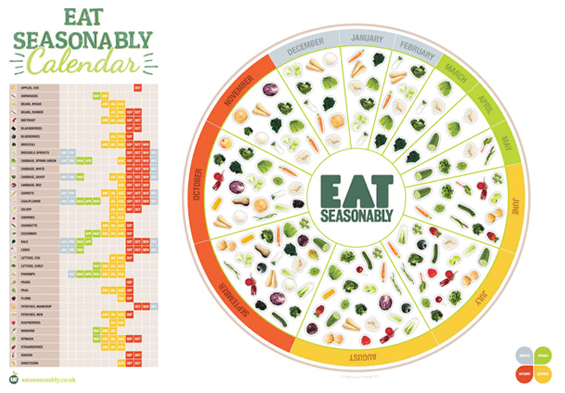
You can find lots of 'eat the seasons' calendars online, including the one below from Eat Seasonably, which you can get as a poster (to pin to your fridge?) and even a tea towel!
My cheat's way of eating seasonally is to get an organic fruit and veg box - if it's not in season, it's not in there, and I don't even have to think about it!
4. Eat more plants
In early 2019 a group of over 30 world-leading scientists from around the globe got together to create a consensus on a diet that was healthy, and sustainable - capable of feeding 10 billion people (expected global population by 2050), that would minimise greenhouse gas emissions, prevent any species going extinct, have no expansion of farmland, and preserve water. Not asking much hey...?
The headline figures they came up with are:
- 100g red meat a week
- 200g chicken a week
- 250ml milk a day
- 200g fish a week
- 1 egg a week
- The majority of our protein should come from pulses and beans - 500g a week
Now there's a distinct lack of cake in that diet for my liking, and I have to confess that we are a long way from the climate ideal in our house but it does go to show what we should be aiming for.
Here are some tips for upping the plants, pulses and beans in your diet:
- Reduce the meat in stews and things like bolognese, and make the rest up with some red or green lentils. I promise you no-one will even notice the difference.
- Try Meat Free Monday (or Tuesday, or Friday - it doesn't really matter..). If you're already nailing that, then can you do 5:2 - 5 days with meat and 2 without, or even 5 days veggie/vegan and 2 days with meat meals?
- Can you go for a plant based lunch? Beans on toast and soup are really easy veggie/vegan options that usually get scoffed in our house!
5. Go plastic-free(ish)
I'm going to start off by saying that I think packaging on food is one of the hardest things to tackle in our homes. I always suggest people start off with some easier bits first, like reusable water bottles and coffee cups, and then look at the bathroom. Some packaging is genuinely helpful in extending the shelf-life of produce (shrink-wrapped cucumbers can prevent waste by up to 2/3), some is needed to protect the product (eg soft fruit) and some is there for the convenience of the supermarkets and consumers.
Sometimes it can feel like trying to figure out the lesser of two evils if we're in the supermarket - organic fruit and veg will often be packaged in plastic in order to differentiate it from the conventional produce, which is a little, shall we say, frustrating..!
If you're like most of us, and stuck with a weekly mad dash around the supermarket, keep your eye out for plastic-free foods - they are there! Porridge oats, and even pasta are now becoming more widely available in cardboard and paper bags. I've got a post here with lots of hints and tips for plastic-free shopping at the supermarket.
Here are some other tips:
- Getting a fruit and veg box will help to massively cut the volume of plastic entering your home, and allows the win-win of organic and plastic-free! If you're on a budget, remember it doesn't have to be all or nothing - can you get a veg box once a month? This would reduce your plastic use by around 25%!
- Check out Zero Waste Near Me to find your nearest zero waste store where you can take your own containers to fill up with all kinds of storecupboard staples, from pasta and rice, to dried fruit. Again, it doesn't have to be all or nothing - if you can visit once a month or every other month and stock up, and then revert back to packaged produce until you can go again, that is absolutely still a Good Thing!
- Go big...! Buy the biggest pack of something and then divide it out at home. For example, we buy the share bags of crisps, and simply pop a handful into a compartment in lunchboxes. We also get the 500g pots of yoghurt and use reusable pouches for the kids to take some to school.
If you want more tips for eating sustainably, check out Episode 74 of the podcast:
