
A BEGINNERS GUIDE TO SUSTAINABLE EATING
In the same way that 'sustainability' and 'sustainable living' will mean different things to different people, 'sustainable eating' will too.
For some people it will be all about veganism and plant-based foods, for others it will be about plastic packaging, or local, or fairtrade, or organic.
The debate around food has a teeny tiny tendency to become very polarising, especially when discussing veganism, which is something I'm really keen to avoid. There is no doubt at all that we all need to reduce our consumption of meat and dairy products, for our own health, and for the planets, but as with all things Sustainable(ish), there is space for nuance. When it comes to the climate crisis and the health of the planet, yes, it's about WHAT we're eating, but it's also about HOW it's been produced as well. As well as carbon footprints we also need to look at soil health, biodiversity and bio-abundance to name just a few things.
It would be really lovely to be able to say "do x, y and z" and I guarantee you you're doing the best thing for the planet. I think that's what all of us want really isn't it? Someone to come along and give us definitive answers. But sadly, frustratingly, there aren't that many definitive answers. Some of it will depend on your own personal values hierarchy.
This isn't a definitive guide. I'm not a climate scientist. Or an ecologist. Or any other kind of -ist.
It's a beginners guide - enough to tickle your tastebuds (see what I did there), give you some 'headline' facts and figures, and then if you're so inclined you can toddle off and do a little extra research. But this should be enough to at least get you started!
1. Reduce food waste
Food waste on the other hand is something we can all get behind.
Here's 3 top tips:
- Do a meal plan - it doesn't have to be anything fancy, but plan ahead for what you're going to eat and when. It sounds dull and boring (because in all honesty it is) but it will cut down your food waste AND save you some cash
- Implement an 'eat me first' box or shelf in your fridge. Then tell everyone in your house they have to eat what's there before they open yet another pot of yoghurt.
- Love your leftovers. Get inventive with your leftovers - turn leftover rice into stir-fried rice, chop leftover pasta into a frittata, blitz up the cauliflower cheese the kids point blank refused to eat into soup (they will eat it. Or at least mine did...)
2. Choose organic
I kind of knew that organic was 'a bit better' for the planet but until I did a mini-series for the podcast with Organic UK, I didn't realise really quite how much better.
Fewer pesticides means that the health of the soil is maintained far more easily, meaning that less fertiliser is needed, greater biodiversity, as well as more carbon sequestered into the soil.
I had no idea about the concept of 'regenerative agriculture' until I recorded the Organic Food and Climate Change episode, but what I learned really blew my mind.
If all of Europe's farmland followed organic principles, emissions from agriculture would drop by 40-50%
Organic soils are 25% more effective in storing carbon on the long-term
Here's some ways to incorporate organic into your diet:
- Get a veg box - look for a local supplier, or check out schemes like Riverford and Abel&Cole
- Can you go 50:50 organic:normal with your milk. Or do like one person did on one of my courses and get a pint less a week, but get organic (so she now gets 5 pints of organic, instead of 6 pints of regular)
- Pick ONE thing to swap for an organic version in your next shop - whether that's fruit and veg, or baked beans, or chocolate, keep your eye out for the logos and make a swap!
3. Eat the seasons
With everything we want available in the supermarkets whenever we want it, it's really easy to lose touch with what's in season. I think we probably all know the obvious ones like strawberries and raspberries, but I have to confess I'd probably struggle if I was pushed beyond that.
The problem is, that when we eat fruit and veg out of it's normal growing season here in the UK (or at least in Europe), it probably means it's been shipped halfway around the world to arrive on our plates.
An air-freighted punnet of strawberries has almost the same carbon footprint (1.8kgCO2) as a raw steak (2kg).
1kg of organic cherry tomatoes grown in the UK in March will have a carbon footprint of 50kg CO2 due to the need for heating of greenhouses.
A 250g pack of local seasonal asparagus has a carbon footprint of 125g of CO2. That same pack air-freighted to the UK from Peru in January has a carbon footprint of 3.5kg (28x greater)!!
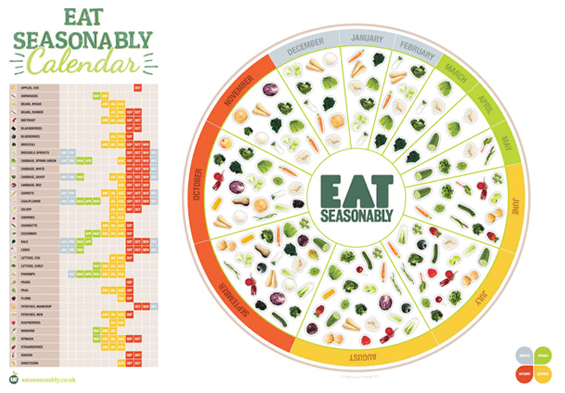
You can find lots of 'eat the seasons' calendars online, including the one below from Eat Seasonably, which you can get as a poster (to pin to your fridge?) and even a tea towel!
My cheat's way of eating seasonally is to get an organic fruit and veg box - if it's not in season, it's not in there, and I don't even have to think about it!
4. Eat more plants
In early 2019 a group of over 30 world-leading scientists from around the globe got together to create a consensus on a diet that was healthy, and sustainable - capable of feeding 10 billion people (expected global population by 2050), that would minimise greenhouse gas emissions, prevent any species going extinct, have no expansion of farmland, and preserve water. Not asking much hey...?
The headline figures they came up with are:
- 100g red meat a week
- 200g chicken a week
- 250ml milk a day
- 200g fish a week
- 1 egg a week
- The majority of our protein should come from pulses and beans - 500g a week
Now there's a distinct lack of cake in that diet for my liking, and I have to confess that we are a long way from the climate ideal in our house but it does go to show what we should be aiming for.
Here are some tips for upping the plants, pulses and beans in your diet:
- Reduce the meat in stews and things like bolognese, and make the rest up with some red or green lentils. I promise you no-one will even notice the difference.
- Try Meat Free Monday (or Tuesday, or Friday - it doesn't really matter..). If you're already nailing that, then can you do 5:2 - 5 days with meat and 2 without, or even 5 days veggie/vegan and 2 days with meat meals?
- Can you go for a plant based lunch? Beans on toast and soup are really easy veggie/vegan options that usually get scoffed in our house!
5. Go plastic-free(ish)
I'm going to start off by saying that I think packaging on food is one of the hardest things to tackle in our homes. I always suggest people start off with some easier bits first, like reusable water bottles and coffee cups, and then look at the bathroom. Some packaging is genuinely helpful in extending the shelf-life of produce (shrink-wrapped cucumbers can prevent waste by up to 2/3), some is needed to protect the product (eg soft fruit) and some is there for the convenience of the supermarkets and consumers.
Sometimes it can feel like trying to figure out the lesser of two evils if we're in the supermarket - organic fruit and veg will often be packaged in plastic in order to differentiate it from the conventional produce, which is a little, shall we say, frustrating..!
If you're like most of us, and stuck with a weekly mad dash around the supermarket, keep your eye out for plastic-free foods - they are there! Porridge oats, and even pasta are now becoming more widely available in cardboard and paper bags. I've got a post here with lots of hints and tips for plastic-free shopping at the supermarket.
Here are some other tips:
- Getting a fruit and veg box will help to massively cut the volume of plastic entering your home, and allows the win-win of organic and plastic-free! If you're on a budget, remember it doesn't have to be all or nothing - can you get a veg box once a month? This would reduce your plastic use by around 25%!
- Check out Zero Waste Near Me to find your nearest zero waste store where you can take your own containers to fill up with all kinds of storecupboard staples, from pasta and rice, to dried fruit. Again, it doesn't have to be all or nothing - if you can visit once a month or every other month and stock up, and then revert back to packaged produce until you can go again, that is absolutely still a Good Thing!
- Go big...! Buy the biggest pack of something and then divide it out at home. For example, we buy the share bags of crisps, and simply pop a handful into a compartment in lunchboxes. We also get the 500g pots of yoghurt and use reusable pouches for the kids to take some to school.
If you want more tips for eating sustainably, check out Episode 74 of the podcast:

