Homepage – blogs – Sustainable(ish)

No Mow May – what you need to know!


Lock up your lawnmower and get ready for No Mow May!
No Mow May is an annual campaign from Plantlife, now in it's 8th year.
The idea is simple, don't mow your lawn during May to allow the grass to grow and to give insects and pollinators a better chance. But it's often not quite as easy as that. Our gardens are often fulfilling multiple roles eg as areas for children to play, and modern gardens aren't really designed with nature and wildlife at the front of mind. 

In a recent podcast episode I chatted to Sarah Shuttleworth, Specialist Botanical Advisor at Plantlife, all about the campaign, and to get some questions answered. From that I've pulled together an entirely made up list of 'FAQs' that is hopefully helpful!


Q. I like my lawn to look neat - why should I take part?

A. In the UK we have lost 97% of our species rich grasslands, with a devastating impact on insects and other wildlife.
If you add up the total area of our gardens, it’s equal to an area bigger than all our national parks. By letting our grass grow longer, we can provide much needed habitat for wildlife.

Q. I’ve already mown my lawn this year - can I still take part?

A. Yes!
Leaving some unmown areas in the summer months is what we’re aiming for so it doesn’t matter if you’ve mown in early Spring.

Q. I’m worried the neighbours will complain.

A. Make a sign, like the blue heart in this pic, or download one from the Plantlife website.

Q. I don’t have a lawn - can I still take part?

A. Yes!
Talk to your local school, church, or other community group.
Or grow a meadow in a pot!
Check out the
blog post on the Plantlife website for more ideas.

Q. Will I end up with a beautiful wildflower meadow?

A. Probably not (sorry!).
But you will end up with far more wildlife than you would have done, which is what we’re after!

Q. What do I do at the end of May?

A. Ideally keep going!
How about ‘Let it Bloom June’? Or ‘Knee High July’?! And then cut at the end of the summer.

Q. How do I stop my husband obsessing about the lawn and wanting to mow it..?

A. Literally no idea. Answers on a postcard please.
(Before everyone goes nuts in the comments, this is tongue in cheek, I know it’s ‘not all husbands’. And also that boyfriends/wives/girlfriends/partners etc might also have different views on lawn mowing during No Mow May...)


Do check out all the brilliant resources (including free downloadable signs, and social media graphics) on the Plantlife website.

And sign the No Mow May pledge!

JOIN THE SUSTAINABLE(ISH) COMMUNITY!
Join over 6000 subscribers to the Sustainable(ish) weekly(ish) newsletter - get tips, ideas, and inspiration for imperfect eco-action, and all the Sustainable(ish) latest news, straight into your in-box!


[200] 200th episode celebration, reflections, and ripples!

Welcome to Episode 200!

200 episodes feels a little bit mad! 
A LOT has happened: globally, in the sustainability space, and for Sustainable(ish).
In this solo episode, I take a little trip down memory lane, share the Top 5 episodes by download numbers, and share your podcast ripples ie the things that you've gone and done, the changes you've made, after listening to an episode.

I'm going to be having a break for a couple of weeks, but in the meantime I will republish some of the episodes that are mentioned in this one, as having inspired action!


LISTEN...


USEFUL LINKS:


[199] No Mow May with Sarah Shuttleworth from Plantlife

Did you know we have lots 97% of our species rich graslands in the UK since the 1930s?
This has had a huge knock on impact to the rest of the food chain that are relaint on that habitat, things like our insect pollinators especially, but also our birds and mammals that were part of this ecosystem.
The good news is that this is something most of us can do something about!
If you have a garden, or have local green spaces, we can use them to recreate some of that lost speices rich grassland, and you don't need masses of space to be able to do it.
AND this is one of those very rare things - a sustainability action that actually requires LESS effort than the status quo, because to make it happen, we're being asked to mow LESS!

In today's episode I'm chatting to Sarah Shuttleworth, Specialist Botanical Advisor at Plantlife, all about their No Mow May campaign, and how we can all get involved, even if we don't have a garden, and/or the rest of the family aren't keen on having an entirely unmown lawn for the whole of the summer!

Have a listen, and then head over to the Plantlife website to sign up to take the No Mow May pledge . There are links to all of the fab No Mow May resources on the Plantlife website, including things like downloadable signs you can print out to let the neighbours know what you're doing!

Sarah Shuttleworth

A bee orchid - Sarah's favourite plant!


LISTEN...

How to reduce your pet’s carbon ‘pawprint’


Pets can bring a huge amount of joy into our lives, but as with everything, they have an environmental impact.
In a recent podcast episode, I chatted to sustainable vet Laura Binnie about how we can reduce our pet's carbon 'pawprints' - here are the key takeaways. (NB. Each of the points below could be a post in themselves! I've tried to be concise, and link out to further resources for anyone who wants to take a deeper dive).


1. Owning a pet can bring a huge amount of joy into our lives, as well as physical and mental health benefits!

2. Choose well

The type of pet you have will have a big impact on it's carbon pawprint.
- Smaller herbivores such as rabbits, guinea pigs, hamsters etc will all have a tiny carbon footprint, due to their plant based diets, and their small size.
- Cats and dogs will have a larger carbon footprint due to their diet.

The bigger the animal, the more it will need to eat, and the bigger it's impact will be.
- It's also worth giving some thought BEFORE you buy a cat or dog as to the size and breed you want.

Bigger dogs will be be more expensive to feed, and when it comes to veterinary interventions, as they need more medication. Some breeds are predisposed to certain diseases, and more likely to need veterinary care, which is obviously not good for the pet, your bank account, or the planet.
Brachycephalic dogs (dogs with very short noses/squashed faces) eg pugs, French bulldogs etc, are more likely to have respiratory problems. But they aren't the only ones with disease predispositions: Cavalier King Charles Spaniels are prone to heart problems; Westies tend to get skin problems; Labradors can get joint problems; Daschunds are prone to back problems, to name just a few. 

It's well worth doing your research when deciding on a breed, and your vet should be happy to advise you on the breeds that will best suit your lifestyle, and any conditions to look out for.

A photograph of a Border terrier lying on a beanbag

"Spud" - our Border Terrier


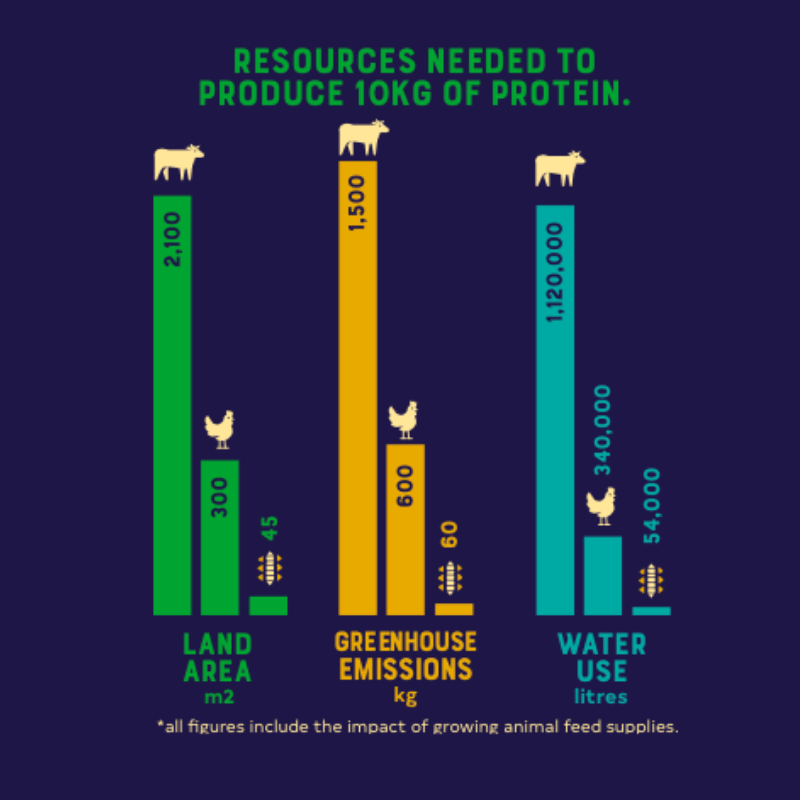
A bar chart showing the comparison of the resources needed to produce 10kg of protein. The bar chart compares beef, chicken and insects, looking at land area, greenhouse gas emissions, and water use. The chart shows beef using the most land and water, and having the highest greenhouse gas emissions. And insects as the lowest.

Comparison of land, emissions and water use of different foods - from Yora

3. Diet matters

The biggest chunk of your pet's 'pawprint' will come from what it eats (we're talking about cats and dogs here).
Here's some broad brushstrokes:
- Dry food tends to have a lower carbon footprint than wet food.
- 'Premium' brands using high grade cuts of meat have a higher carbon footprint.
- Chicken or fish based foods will have lower carbon footprints than beef or lamb.
- Insect based pet foods have a much lower carbon and land footprint than meat or fish based foods. I did a podcast a few years ago with the founder of Yora, an insect based food - you can listen here.
- Dogs can be fed a vegan diet, BUT NOT CATS. Cats are 'obligate carnivores' and need meat in their diets.

Further resources:
- The British Veterinary Association (BVA) have recently published the findings of their Companion Animal Feeding Working Group which looks in depth at the issues around different dietary choices, from a health, as well as a sustainability perspective. You can read the findings 
here.


4. Weight matters

Vets are seeing more and more overweight and obese patients, who are more prone to things like heart and joint disease, as well as diabetes. Keeping our pets at a healthy weight is better for their health and welfare, and ultimately will decrease the need for veterinary treatment, saving both money and carbon.
Monitor your pet's weight regularly and take advice from your vet on what is a healthy weight, and for weight loss advice.


5. Flea and worm treatments

20 years ago it could be difficult to eradicate flea infestations if they took hold, but all that changed with the advent of 'spot on' treatments for fleas and worms. These are much easier to apply, and much more effective than the sprays that existed previously. However there is now a growing body of evidence showing that these products are leaching into our waterways with a devastating knock on impact on aquatic ecosystems.

Evidence review from Vet Sustain

- We need to move away from the 'prophylactic' (just in case) use of these treatments and in the vast majority of cases, shouldn't be using them year round where there is no indication to.
- Speak to your vet and ask for your pet and household to be risk assessed, so that treatment is only used when needed.
- If you are using spot on treatments on your dog, ideally it shouldn't then be swimming or paddling in outdoor water sources.
- Oral treatments may result in less environmental contamination (more research is needed) but please make sure you poo pick!


Further resources:
The evidence for environmental contamination with parasiticides in UK small animal practice (Vet Sustain)


6. Wildlife impacts

Cats and dogs can both have negative impacts for local wildlife populations.
Cats 
- Playing with your cat (eg with a fishing rod toy) for 5-10minutes a day can reduce it's 'prey drive'.
- Implementing a 'curfew' and keeping them indoors from before dusk until after dawn can reduce predation.
Dogs
- Keep your dog on a lead in areas where there might be ground nesting birds present.


7. Poo bags

This could totally be it's own blog post!
- If you're putting your poo bag into a regular bin, biodegradable and compostable bags will largely behave the same way as regular plastic bags. They won't break down in landfill conditions as there isn't enough oxygen, and many local authorities send their 'residual waste' to be burnt at energy from waste plants.
- You can have a dedicated dog poo compost bin at home - in which case you need poo bags that are certified 'home compostable'. NB. You shouldn't use the resulting compost on any plants that are going to be eaten!
- Reusing plastic bags you already have (eg from bread, fruit etc) is a good option.
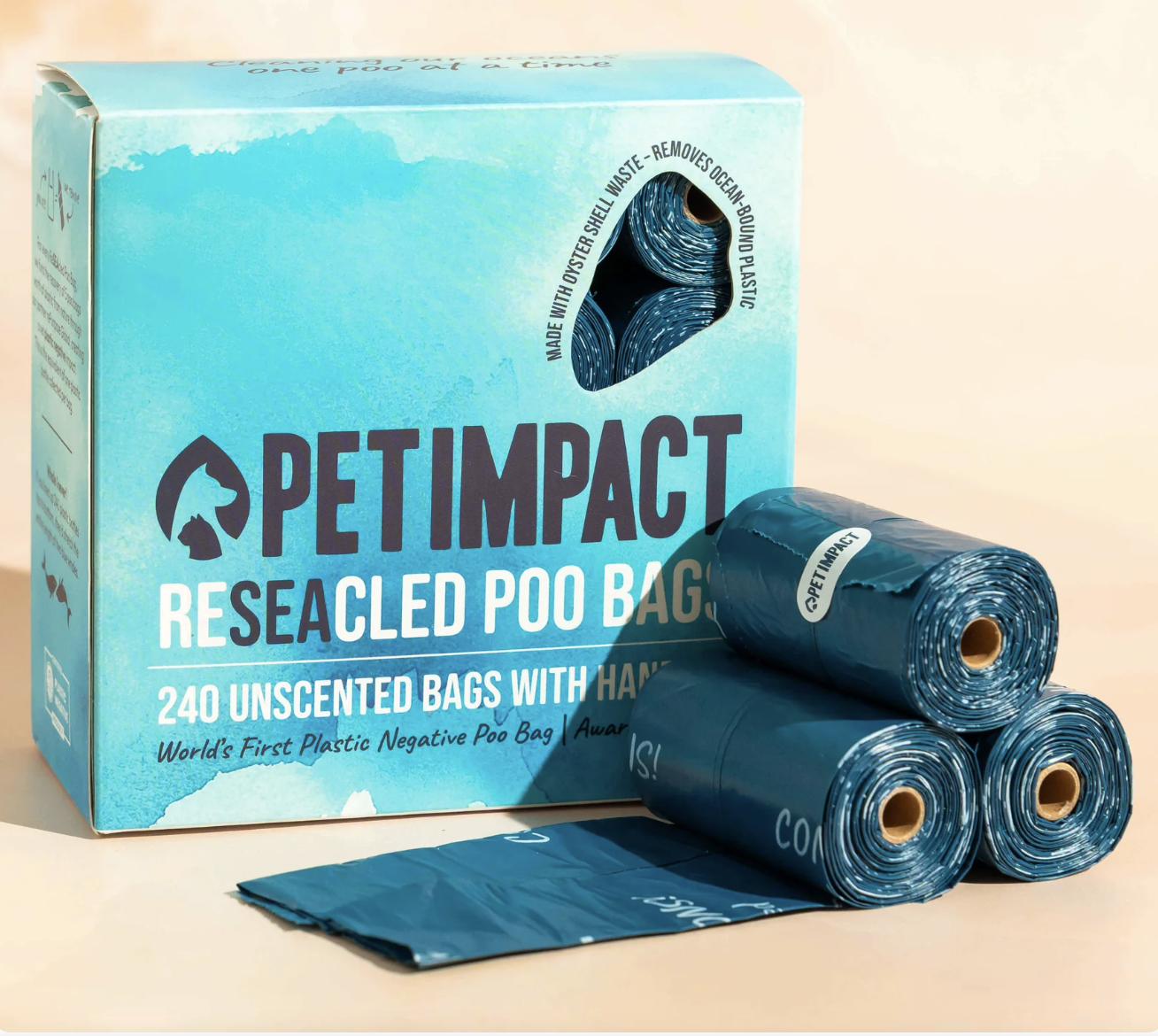
- Another option is poo bags with a high recycled content - I use Pet Impact ReSEAclead poo bags.


Further resources:
- Pet Impact's 'Poo Bag 101'

A photograph of a box of Pet Impact's ReSEAclead poo bags

Pet Impact 'ReSEAclead' poo bags


8. 'Stuff'

Over consumption is as much of a problem in the pet world as it is for the rest of our stuff.
Your dog (and to a lesser extent perhaps, your cat!) just wants to spend time with you. It has no notion of when it's birthday is, or when Christmas is. And while of course we want to treat our pets and show them that we love them, the thing that they want most is probably a nice long walk with lots of time to sniff stuff, or to be played with. They don't need constant new toys, extra food treats put them at additional risk of weight problems, and I can almost 100% guarantee they don't want to be dressed up in a costume for your Instagram feed!


This was a long post! And as I said, each point could be a post in itself. 
As ever, there will be nuance, but I've tried to give the broad brushstrokes.
Please do speak to your veterinary team for advice about any of the above - they will be happy to help!

JOIN THE SUSTAINABLE(ISH) COMMUNITY!
Join over 6000 subscribers to the Sustainable(ish) weekly(ish) newsletter - get tips, ideas, and inspiration for imperfect eco-action, and all the Sustainable(ish) latest news, straight into your in-box!


[198] How to reduce your pet’s carbon pawprint – with sustainable vet Laura Binnie

Pets can bring a huge amount of joy into our lives, but as with everything, they have an environmental impact, and in this episode we're going to dive into where that impact comes from and what we can do to reduce it.
Now I'm very aware that 'sustainability' can sometimes look like being told that all of the things that you love doing, or having, are bad, and that to be truly 'sustainable' you have to stop doing all those things, and suck all the joy and happiness out of your life.
That is absolutely not the case, and it's absolutely not the case for pets. This episode isn't about not having pets, it's about (as I hope all the episodes are!) understanding where the impacts are, and making 'better choices more of the time'. I've got a dog, she adds to our family's carbon footprint, but she also brings a huge amount of joy, and she gets me outside every single day.

I really hope you enjoy this chat with the brilliant Laura Binnie, who is a small animal vet based in Cumbria who has been at the forefront of the sustainability movement in the veterinary profession. It's packed with hints and tips, I've summarised them all in a blog post which I've linked to in the show notes, so hopefully you'll feel more informed about the things you can do to reduce your pets carbon pawprint - enjoy!

Laura Binnie


LISTEN...

[197] Part 2 – Home retrofit. With Sara Grimes from Bath and West Community Energy

This is Part 2, or a 'double header' episode with the brilliant Sara Grimes from Bath and West Community Energy.
Part 1 is all about community energy, and takes a bit of a dive into solar and heat pumps, as well as things like the governments's Warm Homes Plan (it's honestly more fun than it sounds if you haven't already listened to it!)
And this is Part 2, where we talking about all things home retrofit, and looking at some of the less technical , perhaps more affordable options for making our homes more efficient, more comfortable, and cheaper to run.

Enjoy! 

Sara Grimes


LISTEN...

[197] Part 1 – Community Energy, solar, air source heat pumps, and more! With Sara Grimes from Bath and West Community Energy

This week's episode is the first ever two parter!
This was supposed to be an episode on home retrofit, and I'm chatting to SaraG Grimes from Bath and West Community Energy about some of the brilliant work that they're doing, and what people can do in their own homes.

This first part is looking bigger picture and is quite a wide ranging chat! We cover community energy generally, as well as hearing about some of the specific projects that BWCE are working on; solar; heat pumps; the UK government's Warm Homes Plan; and support for renters amongst other things.
In the second part (available to listen to now!) we look more specifically at home retrofit and some of the lower cost retrofit measures available, like draught proofing and insulation.
I'm very aware that both of those potentially sound more than a little dull and dry as podcast episodes, but I really hope that they're interesting and useful! Do let me know!

There we go - I did warn you it was quite a wide ranging chat, but I really hope it was interesting and there were some nuggets there that you can take away.
Part 2 is much more focussed on home retrofit, and some of the lower tehc, more affordable options, and should be available to listen to now if you want to dive straight in, or save that particular treat for another day!
Thanks so much for listening - do let me know any thoughts, comments or questions from this episode, amd I'll catch up in Pt 2

Sara Grimes


LISTEN...

[196] – Everyday influencers (aka the power of YOU!) with Sam Hampton

If you were to google 'how to be more sustainable' you would get a slew of posts sharing 'ten top things to do to cut your carbon footprint' or similar.Very few (if any) mention the huge potential influence that we can all have, by sharing the things that we're doing, talking to other people, voting etc etc.

Which is why when I first came across a paper called 'Choices for climate action: a review of the multiple roles individuals play', and it included these very things, I was super excited, and promptly used it as a framework for diving into climate action in my Carbon Literacy courses.

I was delighted to be able to dive into this in more detail with one of the paper's authors, Dr Sam Hampton, who is an academic at not one, but two universities, Bath and Oxford! We discuss not only the paper I mention above, but a new paper that has just been published about the role of hairdressers as 'everyday influencers' - a phrase I absolutely love! We are ALL everyday influencers, and our choices matter and shape the decisions of those around us. I find this hugely empowering, and I hope you do too!

Sam Hampton


LISTEN...

[195] – Accelerating climate action through sport with Katie Cross from Pledgeball

Football and sport don't perhaps at first glance seem like a natural 'in' for climate action. But did you know..?
- Over 100,000 grassroots football matches are cancelled every year due to bad weather such as flooding
- Over 80% of football fans want are concerned about climate change
- 65% of football fans want their clubs to take more climate action

It was such a joy to get the opportunity to chat to Katie Cross all about Pledgeball - an award winning sports sustainability charity who do an amazing job of empowering sports fans to take action for climate and nature, often framing it around the idea of 'protecting where we play'.
I wouldn't count myself as a football fan, but I took so much inspiration away from this episode and from Katie.  So many clever ways of taking something that people are passionate about and using it as a way in to talk about climate and how it's impacting on that thing that they love, and then harnessing the power of the community that they are already involved in to take action, and to see how their one action contributes to a much greater impact.

Even if you're not a football fan, I think there will be lots to take away from this episode - some way to take a little bit of the work that Plegdeball are doing with football, and in sport more widely, and apply it to the communities that you're already a part of. 

Katie Cross


LISTEN...


USEFUL LINKS:


I'd love to hear if you get your local club signed up, or get your kids school involved, or start something at work around this - do let me know!

[194] – People, Planet, Pint with Adam Bastock

To change the world, you've got to throw a better party than those destroying it".
This is a quote from Louisa Ziane at Toast ale, and is one of my faves, and something I try and keep front of mind.
'Sustainability' has an image problem and is very often seem as something that is dull and dry and bleak, and for the keen greenies over there wearing lots of hemp, or for the lone Sustainability Manager at a company.
It's not really something we'd bring up in conversation down the pub. Or is it..?

Adam Bastock is the founder of People, Planet, Pint - a simple concept of getting like-minded people together 'down the pub' for a chat. From a What's App message at COP26 asking if anyone fancied a pint, People, Planet, Pint now hosts around 80 events every month, in 120 locations around the world! It's such a brilliantly simple idea - one of the things that many of us struggle with is feeling like we're on our own, at the same time perhaps as feeling like the more traditional forms of 'activism' aren't really for us or feel out of our comfort zone. People, Planet, Pint is a great way to connect with other people locally, and to recognise that it's not just you, and that you're not on your own, and who knows what might come of a conversation over a pint (or glass of wine/diet coke/insert other drink choice here!) down the pub.

Photo of Adam Bastock

LISTEN...


USEFUL LINKS:


Do let me know if you have been to your local People, Planet, Pint event, if you're a host,
or if you're now thinking about finding an event local to you,
or perhaps even finding out more about hosting!
If you've enjoyed this episode, please do leave a rating and a review
wherever you listen, and tell all your friends!

1 2 3 70