
Homepage – blogs – Page 6 – Sustainable(ish)

If the words ‘join a climate action group’ make you want to run away and hide…

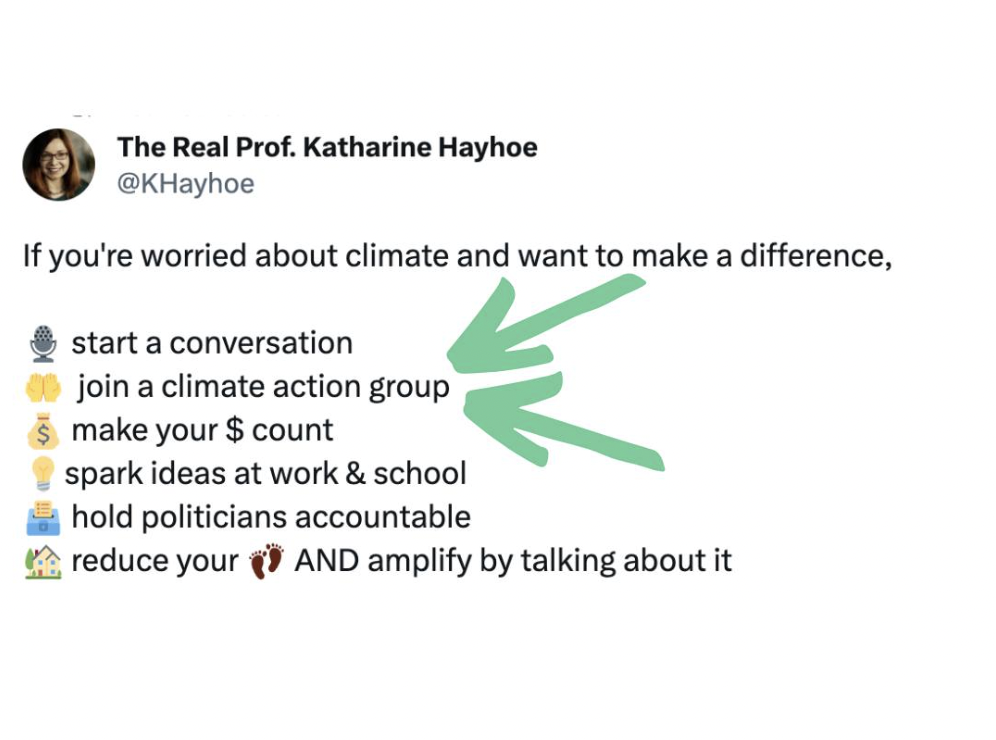
The very brilliant Katharine Hayhoe shared a tweet recently with a list of things we can all do if we're worried about climate change and want to make a difference.
What I loved about it, was that instead of the usual 'Top 5' or 'Top 10' actions we usually see listed like eat less meat and dairy, fly less, drive less etc etc, most of Katharine's suggestions were things that we might not normally think about. And these things that we might not normally think about have the potential to be way more impactful than the usual Top 5/10 lists.

One of them was 'Join a climate action group'.
And I wondered how does 'join a climate action group' make you feel?
I'll be honest, it makes me want to hide.
Just the words 'climate action group' feel super intimidating. Surely that's like some kind of exclusive club for the uber greenies. I feel like it definitely involves a slightly musty smelling church hall and those uncomfortable plastic chairs. And presumably it's full of Boris' 'crusty greenies'. And they're all organising their next protest march or what they're going to glue themselves to next.
(Please know this is tongue in cheek and I have huge respect for crusty greenies, and especially those who slow march and/or glue themselves to stuff - huge thanks to you for being braver than me and taking direct action).

And some climate action groups might be like that.
But that's not what all climate action groups are.
I guess really, a climate action group is simply a group of people coming together to take climate action.
That action could be...

  •  Helping people to repair their broken stuff, in the form of a Repair Cafe.
  • Swapping clothes they no longer want or need for ones that they do, in the form of a 'swish'.
  • Getting together to plant some trees in the local park.
  • Joining up together at work to create a 'green team'.
  • Helping to re-distribute food waste from your local supermarket via a FareShare scheme of similar.

We might not think of these as 'climate action groups' but they ARE groups of people coming together to take climate action! And if you're anything like me, they feel a bit less intimidating than what we might traditionally think of when we think about 'joining a climate action group'.

The power is not necessarily in what you do in your climate action group.
The power lies in joining up with other people.
In realising that you're not alone.
In making connections, having a chat, and a cuppa, and a laugh.
In making friends.
In encouraging each other to take the next step, do the next thing, keep going.

So go one, have a look around - what 'climate action groups' might appeal?


Are you already in a'climate action group'?
Is this something you'd now consider with this different spin on it?
Do let me know!
COME AND JOIN US IN THE SUSTAINABLE(ISH) CLUBHOUSE!

Structure and support to help take you from tired eco-worrier, to empowered and impactful eco-warrior (you'll still be tired, there's nothing I can do about that..!)
  • Annual or monthly membership for tired eco-worriers wanting to make a difference
  • Virtual Clubhouse (FB group)
  • Online library jam-packed with resources
  • Action themes and regular online calls

The paradox of individual climate action…

Too much and not enough - the paradox of individual climate action?

Before I start, let me preface by saying that I know tackling the climate crisis isn't all about individual action - no one is saying it is, and I'm certainly not.
But individual action has a big role to play, and we need to broaden our perceptions of what 'individual climate action' is, because there's a paradox at play.

So here's the (made up) scenario.
I'm out with a friend, who up until now hasn't really shown much interest in climate-y stuff.
She says to me "I'm starting to feel really worried about climate change. I keep seeing on the news all the awful wildfires and floods that are happening around the world. I’m reading articles telling me that climate change is going to impact food prices, and how bad air pollution is for health, and how bad the decline in nature is. I really want to do something. I've been doing my recycling for years but what else can I do?"
So I reel off a big long list of things she could do, emphasising the really big ones like eat less meat and dairy, use your car less, fly less (or not at all).

And on the one hand, it all feels hugely overwhelming.
Making big lifestyle changes is a big ask. Most people fiercely defend their right to choose what they want to eat, to use their car, to fly as much as they want. And may have very valid reasons for not either being able to, or wanting to, make changes.
And I get it. It's hard. I am personally very far from perfect.
People (most people?) want to do something.But the things that will make the biggest difference, can feel too much.

And on the other hand, it all feels way too little.
"Me stopping flying won't make any difference - the plane will still go anyway"
"My individual actions won't make any difference, why should I make all these changes, which feel really hard when the government are doing FA?"
"Are you seriously telling me that in the grand scheme of things, looking at the aftermath pictures of the wildfires in Hawaii and the destruction being wrought around the world, that me doing Meat Free Monday is going to help?"

And I get it. 
Of course we need systemic change.
We need massive government intervention. We need our politicians not only doing the right things, but being seen to be doing the right things.Is this paradox of individual climate action feeling like too much, and simultaneously not enough, stopping people making changes?

This is something I've been thinking about a lot lately.
And it's why we need, urgently, to recognise that individual climate action is about so much more than any reductions to our individual carbon footprint.
It's about the people around us who see us taking that action, and wonder if they could have a go too.
It's about the conversations we have about the action we've taken.
It's about the fact that having taken one action, we're motivated and empowered to take another, and another.
It's about social norms - there's a growing body of evidence that suggest that once 25% of a population start doing things differently (eating less meat and dairy, walking and cycling more, flying less etc etc) that's when we reach a 'positive tipping point' and these things quickly become the norm. We can't reach that 25% without individual people choosing to do things differently. And then talking about it.

And once social norms start to change, social license for climate UN-friendly behaviours, organisations, policies and governments starts to fade.
Once businesses realise that people want something different, they change (we've seen this already with the rise in availability of plant-based options in supermarkets and restaurants).Once politicians realise that people want something different (and are willing to vote accordingly) they'll change.

So maybe there's another paradox at play here too.
It's not all about the individual changes you make. And at the same time, it totally is.


What do you think?
Let me know!

JOIN ME FOR CARBON LITERACY TRAINING!

Get informed about the latest climate science in a judgement-free zone, find out what you can do, and grow your confidence in both taking climate action AND talking about it!

Biodiversity – what is it, why does it matter, and what can we do to help?

May 22nd marked the UN International Day for Biological Diversity. Or Biodiversity.
But what exactly is 'biodiversity' and why does it matter?

These are both great questions (so glad I asked them...) and I will confess that I think I've been a guilty of prioritising climate change, greenhouse gas emissions, waste etc and possibly (holds head in hands in shame) forgetting about biodiversity - seeing it as a 'nice to have'. A kind of add on.

A dictionary definition of 'Biodiversity' is:
"the variety of plant and animal life in the world or in a particular habitat, a high level of which is usually considered to be important and desirable."

Which still kind of makes it feel like a bit of a 'nice to have', right?
When in fact, biodiversity is at the heart of everything. Literally everything.
Biodiversity IS life on earth. And without biodiversity, there is no life on earth.
It's not just the pretty things- eg beautiful insta-worthy flowers or the cute things - eg red squirrels, or dormice (but OMG how cute are dormice?!!) it really is all life on earth.
And it's CRUCIAL.

Biodiversity and 'ecosystem services' provide for things like...
- Having enough oxygen to breathe
- Sequestering carbon dioxide
- Pollinating plants (including food crops - 75% of our food crops rely on pollinators to some extent)
- Healthy soil to sequester carbon dioxide and grow crops, soak up water and help prevent flooding
- Water to drink
And this is just the start of a very long list.

Basically, the less biodiversity we have, the more f*cked we are.
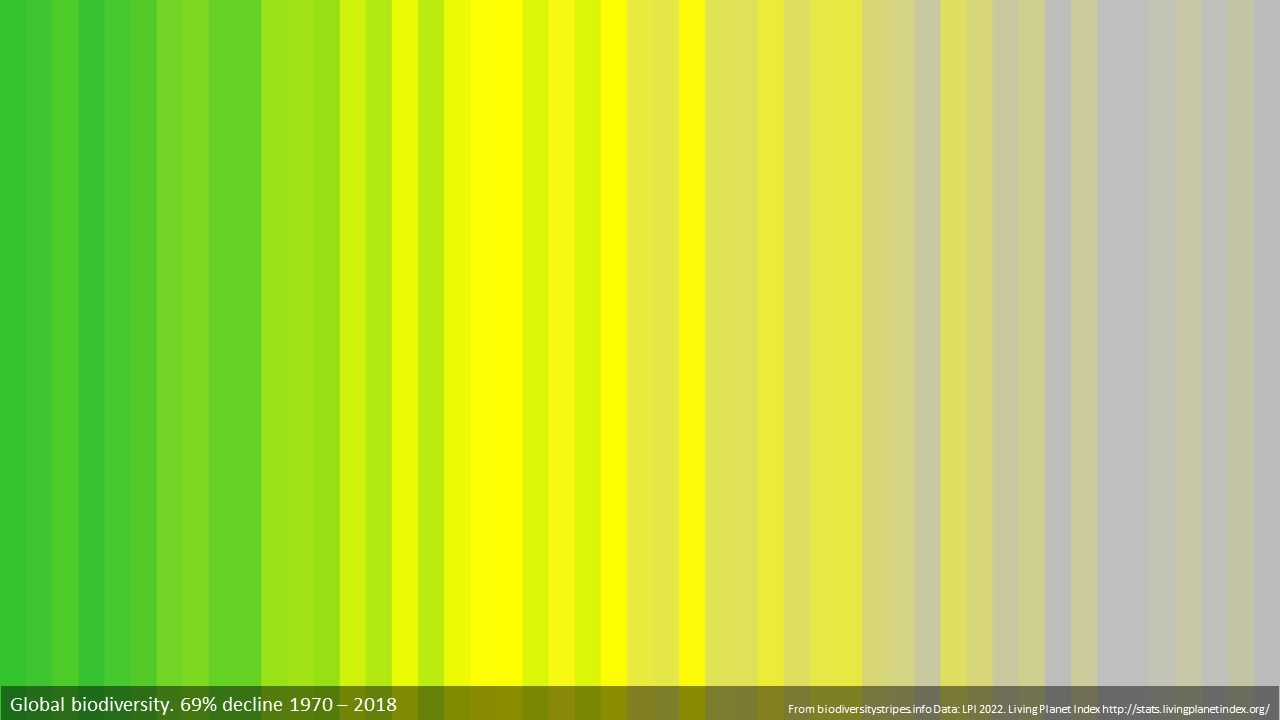
And biodiversity has declined 69% since just 1970.

The Biodiversity Stripes from Miles Richardson, illustrating the 69% decline in global biodiversity from 1970-2018, based on data from Living Planet Index '22

I was born in 1977, so most of this decline has happened in my lifetime, and has happened without us (or certainly me) really noticing.

There are five main drivers of biodiversity loss, of which climate change is one. The others are habitat loss and fragmentation, over-exploitation of natural resources, pollution, and invasive alien species. And although we might bemoan the fact that climate change doesn't get any near the amount of media coverage or column inches that it needs to, biodiversity gets far far less attention from both the media and the general public.

The good news is that we can ALL do something about it.
Here's some ideas...


Consume less
Over consumption in the developed world is a direct driver of habitat loss, over-exploitation of natural resources, climate change and pollution - all of which directly impact biodiversity loss. Think before you buy. And think secondhand first


Eat more plants and nuts and don't waste food
75% of the world's freshwater resources and 1/3 of the earths surface are used for agriculture and farming.
Meat and dairy are generally more land, water and resource intensive than plant based diets. Reducing meat and dairy and tackling food waste are both super impactful choices.


Encourage wildlife and biodiversity in your local area
-  If you're lucky enough to have a garden, aim to devote at least a 1/3 of it to wildlife. The acreage of gardens in the UK is greater than that of our nature reserves, so we can have a real impact!
- Speak to your workplace about any green spaces they own
- Engage with your local schools, churches and council around policies to increase biodiversity


Get out in, and connect with nature
We only protect the things that we love, so we need to spend time in nature to really appreciate it. 
For many of us, lockdown really made us more aware, and more appreciative of, the nature on our doorsteps. But if feels like we have been quick to forget those lessons.
I'm aware of the irony of recommending tech and apps to help you connect with nature, but I've found both the Seek and the Merlin Bird ID apps invaluable. The Seek app helps you to ID plants, birds, animals and insects by picture, and the Merlin one can ID birds from recordings on your phone!  


Back the Climate and Ecology Bill
Zero Hour is the campaign for the Climate and Ecology Bill, formerly the CEE Bill, a plan for a new UK law that addresses the full extent of the climate and nature crisis in line with the most up-to-date science. Check out the campaign, support it, e-mail your MP!


Spread the word!
Share this post!
Talk to your friends and colleagues about it and some of the things that you're doing to help.
Get a blue heart for your front garden - this helps to raise awareness of the fact that you're 're-wilding' your garden (or part of it!) and hopefully sparks some conversations!  


What one thing will YOU do TODAY...?
Let me know in the comments!

JOIN THE SUSTAINABLE(ISH) COMMUNITY!
Join over 6000 subscribers to the Sustainable(ish) weekly(ish) newsletter - get tips, ideas, and inspiration for imperfect eco-action, and all the Sustainable(ish) latest news, straight into your in-box!


23 in 23!

I'm very aware that I've pretty much missed the January New Year's Resolution boat, and I was worried it was too late to be launching any kind of 2023 activity. But then I figured that maybe lots of us are feeling like we missed the January boat and would appreciate a spot of motivation for doing some planet positive stuff regardless of the time of year?
I floated this idea in The Sustainable(ish) Clubhouse and it seemed to go down well, so I'm now sharing more widely.

Here's what it is...23 in '23!
I've put together a big list of over 70 ideas for Sustainable(ish) things we can all have a go at, based on Imperial College Londons '9 things you can do about climate change' article and the brilliant work of  Take the Jump.
Your mission, if you choose to accept it, is to pick 23 to do in 2023.
The plan is that I'll create some content/resources to help with each one over the coming weeks.

The ideas are just that, ideas. Take the ones you want to focus on this year, ignore the ones that don't work for you at the moment, joyously cross off the ones you've already done!
Remember that you can 'ish' any of the ideas to make them work for you and your family. And there's space to add your own ideas too as it's by no means a comprehensive list.

Sign up to access the download here - the first two pages are the ideas, then there's a blank bingo style sheet for you to add in your ideas - one per square - so you can cross them off as you do them.

Once you've come up with your 23 in '23, do share - either drop me an e-mail or share on social media tagging @sustainableish.  Hopefully this will inspire others to have a go. Use the hashtag #23in23 and maybe we might even get a mini movement going?!

Let me know in the comments is this is helpful!

JOIN THE SUSTAINABLE(ISH) COMMUNITY!
Join over 6000 subscribers to the Sustainable(ish) weekly(ish) newsletter - get tips, ideas, and inspiration for imperfect eco-action, and all the Sustainable(ish) latest news, straight into your in-box!


[164] Your council and climate action – with Annie Pickering

Most of us limit our interactions with our local authority to whingeing about our bin collections and paying our council tax BUT did you know that they have a whole lot of carbon emissions within their influence and therefore a whole lot of potential for a positive planetary impact?
But how do we know what our council are doing? And if their plans are any good? And how they compare to the county next door, or at the other end of the country?

This is where today’s guest comes in!
I’m chatting to Annie Pickering from Climate Emergency UK, a not for profit who are supporting local authorities to achieve faster emissions reductions. Last year they assessed the climate action plans of all the local authroties in the UK and ranked them in a set of council climate plan scorecards – I use these regularly in my Carbon Literacy training and also in my talks when I’m talking about spheres of influence and the role we can play as citizens – these scorecards are a great ‘hook’ to get in touch with your local authority and start a conversation about climate action.

This year they’re going a step further and are assessing and ranking local authorities on their actual climate actions, rather than their plans, and this is where we come in!
Not only can we use these tools (the current one now and the new one when it’s available in Autumn of 2023) to engage with our councils around climate action, but if anyone has been looking for climate volunteering opportunities that they can do from the comfort of their homes, then this could be the one for you!
Climate Emergency UK are looking to recruit a small army of volunteers to help them to assess the CA plans of all the local authorities in the UK – a somewhat mammoth undertaking! They’ll provide full training for you and it looks like a brilliant opportunity to get involved in something that really is having a meaningful impact – you’ll hear in our chat about some of the impact that the plan scorecards have already had, so it’s exciting to think about what the action scorecards will achieve!
I’ve already signed up – if you’re interested, here's the link.

Enjoy!

PS. If you’ve enjoyed the podcast this year, please do give me a Christmas pressie of a rating and review whether you get your podcasts – it really does help the podcast to grown and reach more people!  


LISTEN...


CHECK OUT...

  • Climate Emergency UK
    -

[163] The Carbon Footprint of Christmas and what’s in your control

In this episode we take a deep dive into the carbon footprint of Christmas.
Which feels a bit weird right?
Christmas is a time to let go a little, and not be so hung up on the consequences of our actions (hence the number of mince pies I may have already eaten..). I feel a bit guilty for flagging up the fact that our Christmas excesses still have an impact.
But unfortunately we can't bury our heads in the sand. And fortunately, there are LOTS of things we can do to tweak our Christmas' to make them a bit more sustainable(ish), without having to give up all the bits we love and enjoy.


However, I think we can all relate to the fact that creating change, at any time of year, can be hard. And making different choices at Christmas can feel nigh on impossible. 
So it's important to think about what's in your control (do some of these things!) and what isn't (try and let these go..).

Tune in to hear more about the carbon footprint of Christmas, and how to reduce your stress levels (hopefully!) by figuring out what are the things you might be able to change, and what are the things that other people are in control of, where you just have to go with the flow.


LISTEN...


CHECK OUT...

[162] COP27 Explainer – what happened, what didn’t happen, and why? With Laura Young

COP 27...
What happened?
What didn't happen?
And why?

For those of us in the UK, COP26 in Glasgow last year felt like a BIG deal - it was everywhere in the media while it was running, and schools, businesses and organisations were all keen to get involved.
This year's COP (COP27) has felt very different. And I found myself struggling to follow what was going on, and getting a handle on any outcomes.

I'm so delighted that the brilliant Laura Young was able to make some time to come back on and chat to us all about it. Laura was at COP26 last year, and did a brilliant Beginner's Guide to COP26 episode for us, followed up by a debrief afterwards. And it was fabulous to chat to her about what happened at COP27.
SO MUCH to take away from this episode - I feel so much more informed after chatting to Laura, I hope you do too!

And of course, I LOVED Laura's call to action at the end - to make our voices heard not just about the stuff we DON'T want to be happening in our local area (eg fracking) but super importantly to make our voices heard around the stuff we DO want to see happening (eg cycle lanes, onshore wind etc).
What positive stuff has happened near you? Or is in the pipeline? Who can you contact to let them know that they have your support?

Enjoy this episode!


LISTEN...


CHECK OUT...

  • Laura Young
    -

The Carbon Footprint of Christmas (and 12 ways to reduce it!)

In this post here, I share some stats for the carbon footprint of "Christmas" for 3 different scenarios:

  • Low carbon scenario - 4kg CO2e per adult
  • UK average - 280kg CO2e per adult
  • High carbon scenario - 1500kg CO2e per adult

An important point to note, is that these figures (from Mike Berners-Lee's How Bad are Bananas?) are only including excess - so unwanted presents, wasted food, avoidable travel, fairy lights and cards!
So we can see that Christmas can be a pretty wasteful time of year (see this post here for some not so fun festive waste stats) not just in terms of our groaning black bins come the New Year, but also in terms of the excess greenhouse gases our heavy consumption at this time of year is pumping out into the atmosphere.

So should we just cancel Christmas?
Of course, that would be the 'greenest' option, but here at Sustainable(ish) it's all about trying to figure out how we can still do the things we love, in a less impactful way. And fortunately there are lots of things we can to reduce the carbon footprint of our festivities without having to resort to cancelling Christmas.  


1. Give less and give better


According to Mike Berners-Lee, one of the biggest 'pieces of the pie' in that high carbon scenario is unwanted gifts. And apparently 81 million unwanted gifts are received each year, with 1 in 10 unwanted gifts ending up in landfill! (1)
Can you prune your list? Buy for kids only? Do a secret santa? 
Martin Lewis aka The Money Saving Expert has been talking about this since 2013 when he first started talking about his 'no unecessary present pact'. You can read more about it here.


(Genuine fact: The Society for the Prevention of Useless Giving was a campaign group founded in New York in 1912, against pointless gifts at Christmas in response to what the women perceived to be unnecessary Christmas-related materialism. Membership grew to 6,000 people by 1913 but stalled in Christmas 1914 due to the outbreak of WW1 in Europe.) 


2. Keep the receipts!


Really encourage people to be honest in their reactions to your presents. Emphasise that no offence will be taken, and that you'd rather return it and either get them something else (after consulting with them!) or give them the money, rather than something sitting there unloved and wanted and possibly ending up in landfill.


3.Reduce food waste


Food waste is another of the big chunks of the Christmas carbon footprint, and we waste around 7million tonnes of food at Christmas (3).

Make a meal plan for the festive fortnight - where you'll be when, and how many you're expecting for meals when you're at home. Factor in leftovers, and make good use of your freezer! Lots more food waste reduction tips here.


4. Send fewer cards


It never really occurred to me that most of the footprint from sending a Christmas card comes from the postal service, but when you think about it, it makes total sense.
Whilst it might not be possible to eradicate your Christmas card list entirely (many people have elderly relatives who really love receiving cards) but could you cut down a little? E-cards are an increasingly popular option, and if you're sending cards to local people, can you bike or walk and post by hand - who knows, you might even be invited in for a cuppa and a catch up! (And if you're thinking "Oh god, no thanks, not sure I want a cuppa and a catch up with xxx", maybe you don't need to send them a card..?!!)


Christmas cards from kids to every other child in their class is a problem I was naively unaware of until my own started school. And then I spent several years battling with my kids to get them write 30 of the bloody things, and then latterly feeling very guilty at the sheer waste generated. 30 kids in a class, each sending each other a card is 870 cards and envelopes. For one class! Multiply that by the number of classes in the school and you're suddenly looking at a LOT of card and paper. Even if it's all recycled afterwards. 
If you get in early, you might be able to whizz off a quick e-mail to your class teacher, or even headteacher, suggesting that each child can make one card, and that these can be displayed on the wall?


5. Green your fairy lights

With energy prices at record levels, we're all watching the bills this winter.
Check out your fairy lights to see if they're LED - these use way less energy than the old-fashioned types. Make sure you take any older style ones to the WEEE recycling at your local recycling centre.
Turn your lights off overnight and when you're out, and if you have a timer plug or a smart plug, use this to make sure you don't leave them on overnight accidentally.


6. Trim your Christmas dinner

This is a great graph from this article here that dives into the carbon footprint of our Christmas dinner:

So beef and lamb are the highest carbon options. And turkey has 3x the footprint of chicken!
There aren't any veggie or vegan options shown on here, but clearly they would have even lower footprints. It's also worth noting:
- Organic veggies will have a lower impact than conventional
- Avoid air-freighted and out of season foods if you can - so no mange tout, strawberries, blueberries etc
If you're feeling super geeky, you can even work out the carbon footprint of your very own Christmas dinner using the Floop app! They've got a brilliant blog post where they've broken down the footprint of a typical Christmas dinner.


7. Real vs artificial tree

This is a good video here from the BBC that explains where the footprint of different Christmas tree choices is coming from. 

- Artificial Christmas trees - if you have one, or you buy one, keep it in use for as long as possible. It needs to be used for around 10 years before it has a lower impact than a real tree. But even then it's still impossible to recycle and will end up in landfill.


- Real Christmas trees - buy locally grown, and make sure it's composted or mulched after you're done with it.

 
OR buy one with roots that you can plant out.
OR rent one! 
OR upcycle like we do - we made our pompom tree from secondhand yarn about 5 years ago and it's still going strong and always sparks off some great conversations!


8. Stay grounded


Potentially this one is tricky if you have family abroad, BUT for anyone else, not flying at Christmas (unless you have a reindeer powered sleigh) is key. I genuinely think we need to question whether a 2 or 3 day trip to Lapland is a good use of our remaining carbon budget. I feel Scrooge like saying it, and I'm sure it's super magical, but there are loads of good 'winter wonderlands' here in the UK that don't need a flight.


10. Reduce your heating


If you've got lots of extra people in the house and the oven is on a lot, you should be able to get away with reducing the thermostat a degree or two. Not only will this reduce your gas usage and associated greenhouse gas emissions, it will save you money too! According to The Energy Saving Trust "turning your room thermostat down by just one degree could save £60 on your heating bills and 310kg of carbon dioxide a year from your household carbon footprint". Even if you just manage if for a few days over the Christmas period, it will still make a difference!


10. Cook clever


Try to plan ahead so that if the oven is on, it's full. Can you pop a pudding or some mince pies in there while you're cooking dinner?
Embrace your slow cooker - great for batch cooking big meals if you've got family round, but you can also do your Christmas pud in there, using way less energy than boiling away for hours on the hob. 
Using the microwave for re-heating leftovers is also lower energy than putting the oven on.


11. Travel light


Christmas centres around family for many of us, which can mean trawling up and down the country in our cars.
- Can you go by train? Not always possible and possibly fairly pricey, but worth a look! Check out TrainHugger who plant trees for tickets!
- If you have already have an EV, then that's great. If not, could you rent one for the week? Have a look to see if the Karshare scheme is up and running locally to you - I did a podcast with them and it sounds like a great idea!
- Stick to the speed limit....! The faster you go, the less efficient it is...
- Pack well - if you can, try and get everything inside the car - roof boxes add to drag, meaning you'll burn more fuel.
- Plan well - if possible, try and plan your trips to avoid the expected busy periods, saving you the petrol burned sitting in tailbacks.


12. Think secondhand first


Secondhand gifts, Christmas jumpers, nativity costumes and decorations will ALWAYS be a lower carbon option. You're making use of the energy and resources that have already gone into a product, potentially saving something from landfill, AND saving money - what's not to love?! 


References

(1): https://www.ribbex.co.uk/news/one-in-10-unwanted-christmas-gifts-ends-up-in-landfill/
(2): https://en.wikipedia.org/wiki/Society_for_the_Prevention_of_Useless_Giving
(3): https://commercialwaste.trade/food-waste-christmas/


Have you got any plans for a lower carbon Christmas this year?
Do share in the comments!
INTRODUCING THE CRAP-FREE CHRISTMAS COURSE!

Packed with hints, tips, ideas and links for a Christmas with less waste and less impact on the planet, one imperfect step at a time!
This is an online self-paced course, meaning you can dip in and out at your own pace and pick and choose what you want to focus on.


What is The Carbon Footprint of Christmas?

Before we start, let's get back to basics. What is a carbon footprint?

Everything we do releases carbon dioxide (and other greenhouse gases) into the atmosphere, and it's these greenhouse gas emissions that are contributing to the greenhouse effect, trapping more heat in, and making the planet warm. All of which leads to climate change and the increase in frequency and extremes of 'weird weather' and the impacts that that has on ecosystems and human lives.

We all have a carbon footprint. The average footprint for an individual in the UK is around 9-10 tonnes (this figure will vary depending on how it's calculated and exactly what's included, but let's work with a round number of 10 tonnes for ease).
There's a great podcast episode with Jo Hand, co-founder of Giki Zero here if you want to hear more about carbon footprints!

The carbon footprint of Christmas comes from everything we buy for the festivities.
And as we buy A LOT at Christmas, it's perhaps no surprise that the carbon footprint of the festive fortnight is the same as that of a regular month.
And obviously the carbon footprint of Christmas will vary depending on how extravagant or otherwise our festive celebrations are.
Mike Berners-Lee is the carbon footprinting King and in his book 'How Bad are Bananas?' he gives three different scenarios:

  • 4kg CO2e per adult for a low carbon scenario
    - The food is great but none is wasted

    - Presents are thoughtful but not necessarily expensive, and you've kept the receipts so you can return any unwanted gifts.
    - You have LED fairy lights.
    - You only send a few cards to people you haven't seen in ages and don't want to lose touch with.
    - You stay home and video call any far-off relatives.
  • 280kg CO2e per adult - UK average
    - Presents - the average spend in the UK is £600 per adult. In this scenario 20% are unwanted (we receive 81 million unwanted gifts each year in the UK!)
    - We spend around £220 more than usual on food, and these figures are based on the assumption that a third will be wasted (shockingly we throw away about a third of our food all year round)
    - Fairy lights burn through about 45kW/h (not clear if these figures are for LED lights or regular ones)
    - The average adult posts about 20 cards, and most of their impact is from delivery
    - We typically travel about 50 miles each, above what we would normally travel, and mostly by car
  • 1500kg CO2e per adult for a high carbon scenario
    - £1400 spend on presents, with a 'wasted-ness' factor of 30% and you don't keep the receipts
    - Loads of non-LED lights
    - Post 200 large cards
    - 500mile round trip in a 'thirsty' car to see relatives

The good news is that there are lots of things we can do to easily reduce our footprint but not the fun factor!
There's a post here with 12 ways to reduce the carbon footprint of your Christmas, but I wanted to share this as well...

Christmas can be a tricky time to make sustainable(ish) changes for lots of reasons.

Firstly, it only happens once a year, so it can feel like starting again each year and it's hard to build on small changes we've made a year ago.
Secondly there's all the traditions and societal expectations that come with this time of year.
And then there's the fact that at Christmas, it tends to not just be us and our household that's involved, there's the wider family, friends, colleagues, school etc etc as well.
Change can be hard at an individual level, and it can certainly be hard to get the rest of the household on board at times, but changing the 'hearts and minds' of in-laws, work colleagues etc etc can feel impossible.

And that's ok, because that's not our 'job'.
If we want to make changes at Christmas to make it a bit more eco-friendly it's super important to focus on what IS in our control. Because a lot of it won't be. We need to make peace with that!
I've put together a little Venn diagram (because who doesn't love a Venn diagram!) with some ideas of things that might be in our control, and things that might not be.

The important thing to note is that overlap (with the bloody great green star in it!)
While lots of things might be out of our control, we might still be able to have an influence over them:

- Can we be ready with a list of things we think our kids will actually love and enjoy playing with when we're asked by relatives what they want for Christmas?
- Can we wrap our own gifts 'furoshiki' style in reusable fabric and rave about how quick and easy it was?
- Can we send an e-mail to our kids school asking them if they'd be up for hosting a Christmas jumper swap for all the kids?

If you fancy it, here's a suggestion for you that might help to take some of the stress out of trying to make Sustainable(ish) changes at Christmas.
Make 3 lists:
1. Things I can control (this is where you can start to make some sustainable(ish) changes!
2. Things I can't control
3. Things I might be able to have some influence over

And keep referring back to it whenever you feel your stress levels start to rise over the festive period..!


Is this helpful?
What's on your lists?
Let me know!

INTRODUCING THE CRAP-FREE CHRISTMAS COURSE!

Packed with hints, tips, ideas and links for a Christmas with less waste and less impact on the planet, one imperfect step at a time!
This is an online self-paced course, meaning you can dip in and out at your own pace and pick and choose what you want to focus on.


[161] Shop Ethical Instead – with Sian Conway-Wood

You might not want to hear this but...Christmas is coming!
We’re about to enter silly season for consumption with Black Friday and then the Christmas shopping, so what better time to take a pause and think about the impact of what we’re buying, and how we might be able to make our money do good stuff at the same time as buying good pressies.

I’m chatting to Sian Conway-Wood who is the founder of ethical business platform Ethical Hour and managing partner at 181st Street – a communications company. Earlier this moth, Sian launched Shop Ethical Instead – a campaign to encourage us to use our Christmas budget to buy gifts from small, ethical independent brands.
Now, as some of you will now, I’m coming to the end of Nothing New in 22 – a year buying gnothing new, 10 years on from the first one that was the star of my own sustainability journey. I’m pretty sold on the message that one of the most powerful things we can do as individuals is to consume less – so I did gently challenge Sian on how she feels about marketing more stuff to us, that we might not really need.

It was a brilliant chat – and I totally sign up to Sian’s mantra of buy less buy better – so if you are on the look-our for some thoughtfully seclted presents for the loved ones in your life, do check out the Shop Ethical Instead gift guides.

And on that note, if you’re looking to do Christmas with a bit less waste, impact on the planet and money this year, then I’ve pulled together the Crap-Christmas Course – a self-paced course with sixteen modules covering everything from plastic-free stocking fillers, through to sustainable(ish) drinks choices for the Big Day. There's more info right here.

Do let me know what you think of this episode and if you'll be checking out some of the wonderful brands Sian mentions.

Enjoy!


LISTEN...


CHECK OUT...

  • Ethical Hour
    -

1 4 5 6 7 8 70