
Biodiversity – what is it, why does it matter, and what can we do to help?
May 22nd marked the UN International Day for Biological Diversity. Or Biodiversity.
But what exactly is 'biodiversity' and why does it matter?
These are both great questions (so glad I asked them...) and I will confess that I think I've been a guilty of prioritising climate change, greenhouse gas emissions, waste etc and possibly (holds head in hands in shame) forgetting about biodiversity - seeing it as a 'nice to have'. A kind of add on.
A dictionary definition of 'Biodiversity' is:
"the variety of plant and animal life in the world or in a particular habitat, a high level of which is usually considered to be important and desirable."
Which still kind of makes it feel like a bit of a 'nice to have', right?
When in fact, biodiversity is at the heart of everything. Literally everything.
Biodiversity IS life on earth. And without biodiversity, there is no life on earth.
It's not just the pretty things- eg beautiful insta-worthy flowers or the cute things - eg red squirrels, or dormice (but OMG how cute are dormice?!!) it really is all life on earth.
And it's CRUCIAL.
Biodiversity and 'ecosystem services' provide for things like...
- Having enough oxygen to breathe
- Sequestering carbon dioxide
- Pollinating plants (including food crops - 75% of our food crops rely on pollinators to some extent)
- Healthy soil to sequester carbon dioxide and grow crops, soak up water and help prevent flooding
- Water to drink
And this is just the start of a very long list.
Basically, the less biodiversity we have, the more f*cked we are.
And biodiversity has declined 69% since just 1970.
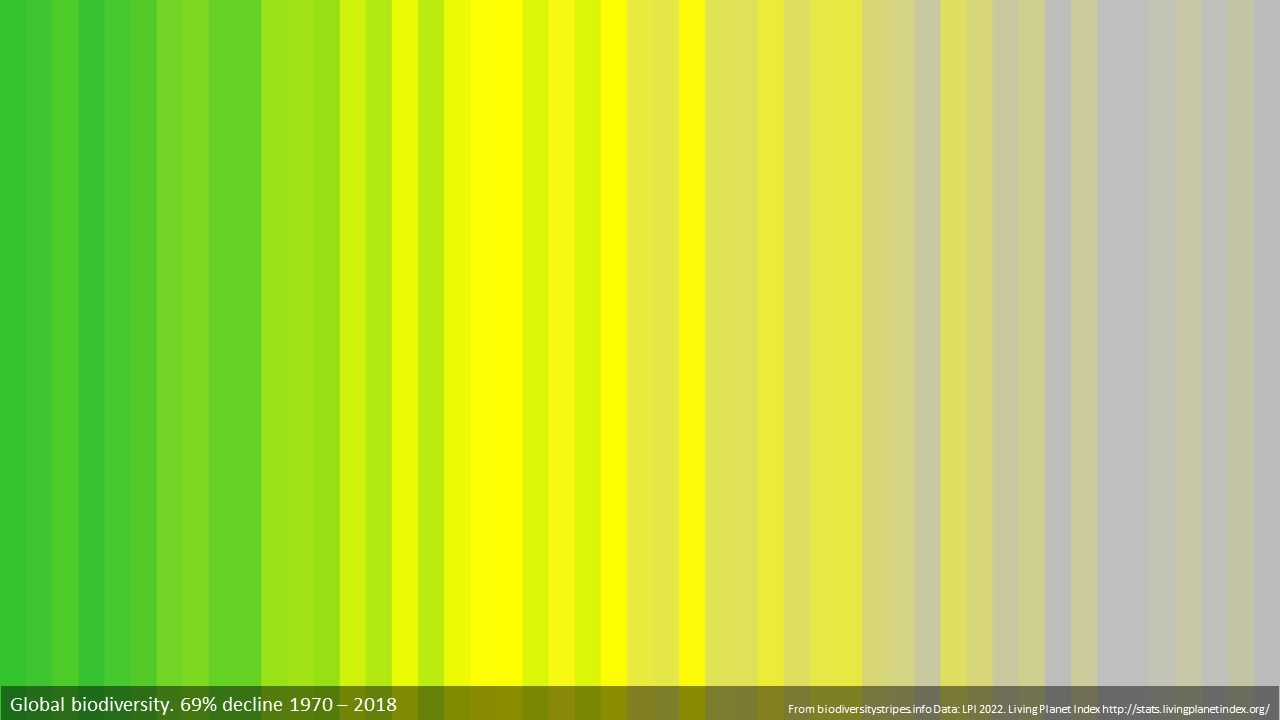
The Biodiversity Stripes from Miles Richardson, illustrating the 69% decline in global biodiversity from 1970-2018, based on data from Living Planet Index '22
I was born in 1977, so most of this decline has happened in my lifetime, and has happened without us (or certainly me) really noticing.
There are five main drivers of biodiversity loss, of which climate change is one. The others are habitat loss and fragmentation, over-exploitation of natural resources, pollution, and invasive alien species. And although we might bemoan the fact that climate change doesn't get any near the amount of media coverage or column inches that it needs to, biodiversity gets far far less attention from both the media and the general public.
The good news is that we can ALL do something about it.
Here's some ideas...
Consume less
Over consumption in the developed world is a direct driver of habitat loss, over-exploitation of natural resources, climate change and pollution - all of which directly impact biodiversity loss. Think before you buy. And think secondhand first
Eat more plants and nuts and don't waste food
75% of the world's freshwater resources and 1/3 of the earths surface are used for agriculture and farming.
Meat and dairy are generally more land, water and resource intensive than plant based diets. Reducing meat and dairy and tackling food waste are both super impactful choices.
Encourage wildlife and biodiversity in your local area
- If you're lucky enough to have a garden, aim to devote at least a 1/3 of it to wildlife. The acreage of gardens in the UK is greater than that of our nature reserves, so we can have a real impact!
- Speak to your workplace about any green spaces they own
- Engage with your local schools, churches and council around policies to increase biodiversity
Get out in, and connect with nature
We only protect the things that we love, so we need to spend time in nature to really appreciate it.
For many of us, lockdown really made us more aware, and more appreciative of, the nature on our doorsteps. But if feels like we have been quick to forget those lessons.
I'm aware of the irony of recommending tech and apps to help you connect with nature, but I've found both the Seek and the Merlin Bird ID apps invaluable. The Seek app helps you to ID plants, birds, animals and insects by picture, and the Merlin one can ID birds from recordings on your phone!
Back the Climate and Ecology Bill
Zero Hour is the campaign for the Climate and Ecology Bill, formerly the CEE Bill, a plan for a new UK law that addresses the full extent of the climate and nature crisis in line with the most up-to-date science. Check out the campaign, support it, e-mail your MP!
Spread the word!
Share this post!
Talk to your friends and colleagues about it and some of the things that you're doing to help.
Get a blue heart for your front garden - this helps to raise awareness of the fact that you're 're-wilding' your garden (or part of it!) and hopefully sparks some conversations!
