Blog Posts – Sustainable(ish)

Category Archives for Blog Posts

No Mow May – what you need to know!


Lock up your lawnmower and get ready for No Mow May!
No Mow May is an annual campaign from Plantlife, now in it's 8th year.
The idea is simple, don't mow your lawn during May to allow the grass to grow and to give insects and pollinators a better chance. But it's often not quite as easy as that. Our gardens are often fulfilling multiple roles eg as areas for children to play, and modern gardens aren't really designed with nature and wildlife at the front of mind. 

In a recent podcast episode I chatted to Sarah Shuttleworth, Specialist Botanical Advisor at Plantlife, all about the campaign, and to get some questions answered. From that I've pulled together an entirely made up list of 'FAQs' that is hopefully helpful!


Q. I like my lawn to look neat - why should I take part?

A. In the UK we have lost 97% of our species rich grasslands, with a devastating impact on insects and other wildlife.
If you add up the total area of our gardens, it’s equal to an area bigger than all our national parks. By letting our grass grow longer, we can provide much needed habitat for wildlife.

Q. I’ve already mown my lawn this year - can I still take part?

A. Yes!
Leaving some unmown areas in the summer months is what we’re aiming for so it doesn’t matter if you’ve mown in early Spring.

Q. I’m worried the neighbours will complain.

A. Make a sign, like the blue heart in this pic, or download one from the Plantlife website.

Q. I don’t have a lawn - can I still take part?

A. Yes!
Talk to your local school, church, or other community group.
Or grow a meadow in a pot!
Check out the
blog post on the Plantlife website for more ideas.

Q. Will I end up with a beautiful wildflower meadow?

A. Probably not (sorry!).
But you will end up with far more wildlife than you would have done, which is what we’re after!

Q. What do I do at the end of May?

A. Ideally keep going!
How about ‘Let it Bloom June’? Or ‘Knee High July’?! And then cut at the end of the summer.

Q. How do I stop my husband obsessing about the lawn and wanting to mow it..?

A. Literally no idea. Answers on a postcard please.
(Before everyone goes nuts in the comments, this is tongue in cheek, I know it’s ‘not all husbands’. And also that boyfriends/wives/girlfriends/partners etc might also have different views on lawn mowing during No Mow May...)


Do check out all the brilliant resources (including free downloadable signs, and social media graphics) on the Plantlife website.

And sign the No Mow May pledge!

JOIN THE SUSTAINABLE(ISH) COMMUNITY!
Join over 6000 subscribers to the Sustainable(ish) weekly(ish) newsletter - get tips, ideas, and inspiration for imperfect eco-action, and all the Sustainable(ish) latest news, straight into your in-box!


How to reduce your pet’s carbon ‘pawprint’


Pets can bring a huge amount of joy into our lives, but as with everything, they have an environmental impact.
In a recent podcast episode, I chatted to sustainable vet Laura Binnie about how we can reduce our pet's carbon 'pawprints' - here are the key takeaways. (NB. Each of the points below could be a post in themselves! I've tried to be concise, and link out to further resources for anyone who wants to take a deeper dive).


1. Owning a pet can bring a huge amount of joy into our lives, as well as physical and mental health benefits!

2. Choose well

The type of pet you have will have a big impact on it's carbon pawprint.
- Smaller herbivores such as rabbits, guinea pigs, hamsters etc will all have a tiny carbon footprint, due to their plant based diets, and their small size.
- Cats and dogs will have a larger carbon footprint due to their diet.

The bigger the animal, the more it will need to eat, and the bigger it's impact will be.
- It's also worth giving some thought BEFORE you buy a cat or dog as to the size and breed you want.

Bigger dogs will be be more expensive to feed, and when it comes to veterinary interventions, as they need more medication. Some breeds are predisposed to certain diseases, and more likely to need veterinary care, which is obviously not good for the pet, your bank account, or the planet.
Brachycephalic dogs (dogs with very short noses/squashed faces) eg pugs, French bulldogs etc, are more likely to have respiratory problems. But they aren't the only ones with disease predispositions: Cavalier King Charles Spaniels are prone to heart problems; Westies tend to get skin problems; Labradors can get joint problems; Daschunds are prone to back problems, to name just a few. 

It's well worth doing your research when deciding on a breed, and your vet should be happy to advise you on the breeds that will best suit your lifestyle, and any conditions to look out for.

A photograph of a Border terrier lying on a beanbag

"Spud" - our Border Terrier


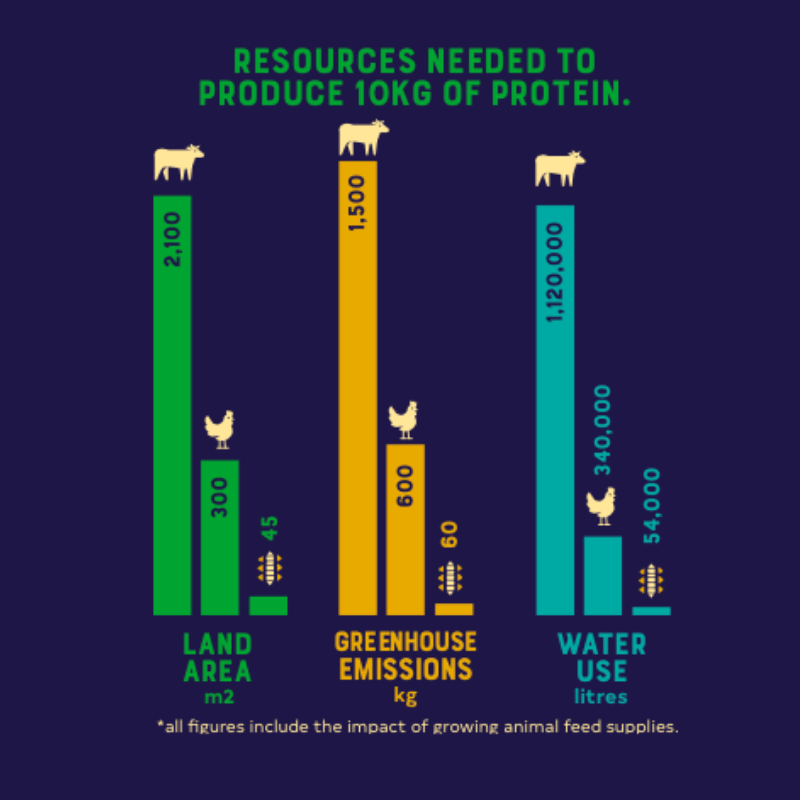
A bar chart showing the comparison of the resources needed to produce 10kg of protein. The bar chart compares beef, chicken and insects, looking at land area, greenhouse gas emissions, and water use. The chart shows beef using the most land and water, and having the highest greenhouse gas emissions. And insects as the lowest.

Comparison of land, emissions and water use of different foods - from Yora

3. Diet matters

The biggest chunk of your pet's 'pawprint' will come from what it eats (we're talking about cats and dogs here).
Here's some broad brushstrokes:
- Dry food tends to have a lower carbon footprint than wet food.
- 'Premium' brands using high grade cuts of meat have a higher carbon footprint.
- Chicken or fish based foods will have lower carbon footprints than beef or lamb.
- Insect based pet foods have a much lower carbon and land footprint than meat or fish based foods. I did a podcast a few years ago with the founder of Yora, an insect based food - you can listen here.
- Dogs can be fed a vegan diet, BUT NOT CATS. Cats are 'obligate carnivores' and need meat in their diets.

Further resources:
- The British Veterinary Association (BVA) have recently published the findings of their Companion Animal Feeding Working Group which looks in depth at the issues around different dietary choices, from a health, as well as a sustainability perspective. You can read the findings 
here.


4. Weight matters

Vets are seeing more and more overweight and obese patients, who are more prone to things like heart and joint disease, as well as diabetes. Keeping our pets at a healthy weight is better for their health and welfare, and ultimately will decrease the need for veterinary treatment, saving both money and carbon.
Monitor your pet's weight regularly and take advice from your vet on what is a healthy weight, and for weight loss advice.


5. Flea and worm treatments

20 years ago it could be difficult to eradicate flea infestations if they took hold, but all that changed with the advent of 'spot on' treatments for fleas and worms. These are much easier to apply, and much more effective than the sprays that existed previously. However there is now a growing body of evidence showing that these products are leaching into our waterways with a devastating knock on impact on aquatic ecosystems.

Evidence review from Vet Sustain

- We need to move away from the 'prophylactic' (just in case) use of these treatments and in the vast majority of cases, shouldn't be using them year round where there is no indication to.
- Speak to your vet and ask for your pet and household to be risk assessed, so that treatment is only used when needed.
- If you are using spot on treatments on your dog, ideally it shouldn't then be swimming or paddling in outdoor water sources.
- Oral treatments may result in less environmental contamination (more research is needed) but please make sure you poo pick!


Further resources:
The evidence for environmental contamination with parasiticides in UK small animal practice (Vet Sustain)


6. Wildlife impacts

Cats and dogs can both have negative impacts for local wildlife populations.
Cats 
- Playing with your cat (eg with a fishing rod toy) for 5-10minutes a day can reduce it's 'prey drive'.
- Implementing a 'curfew' and keeping them indoors from before dusk until after dawn can reduce predation.
Dogs
- Keep your dog on a lead in areas where there might be ground nesting birds present.


7. Poo bags

This could totally be it's own blog post!
- If you're putting your poo bag into a regular bin, biodegradable and compostable bags will largely behave the same way as regular plastic bags. They won't break down in landfill conditions as there isn't enough oxygen, and many local authorities send their 'residual waste' to be burnt at energy from waste plants.
- You can have a dedicated dog poo compost bin at home - in which case you need poo bags that are certified 'home compostable'. NB. You shouldn't use the resulting compost on any plants that are going to be eaten!
- Reusing plastic bags you already have (eg from bread, fruit etc) is a good option.
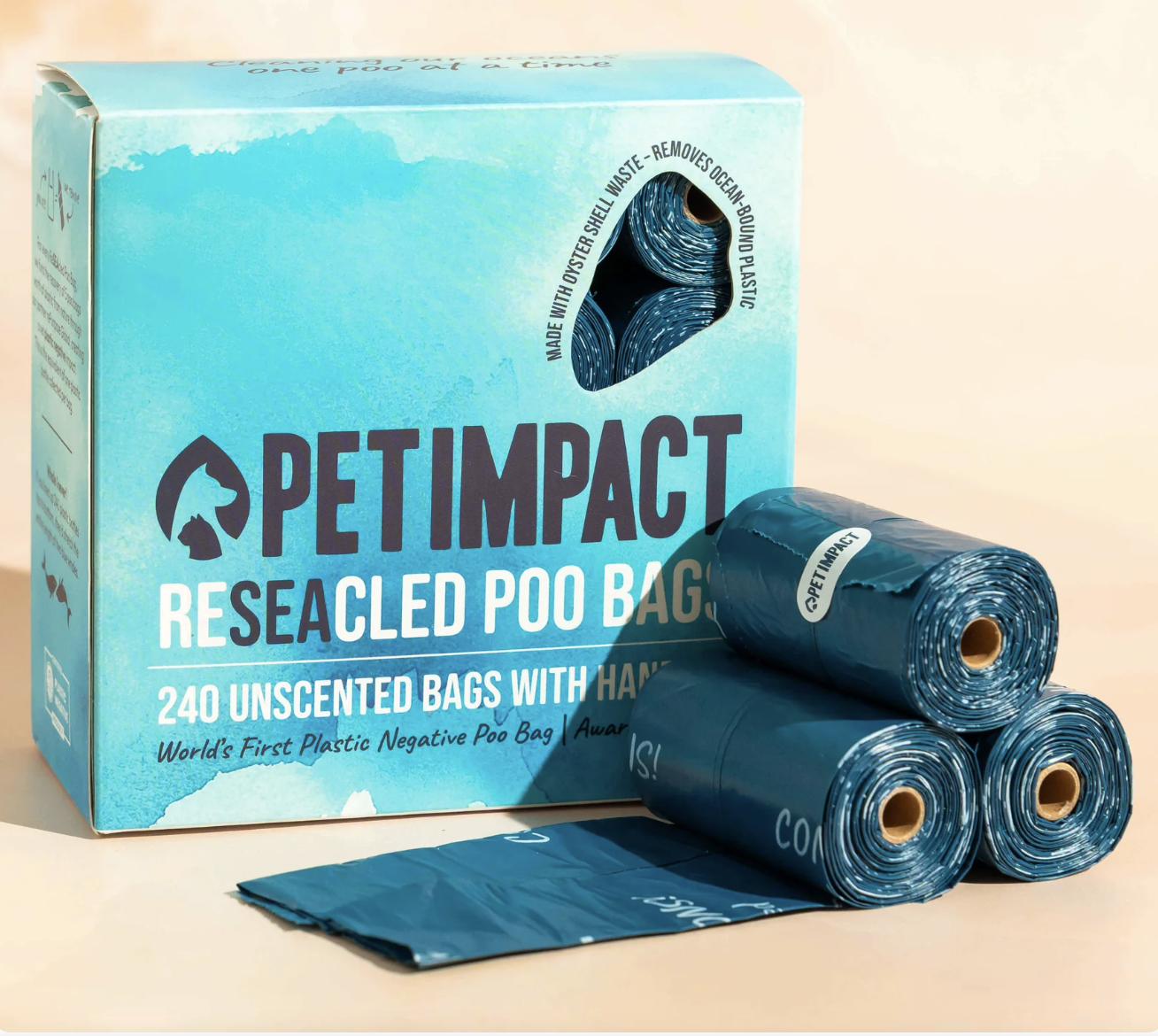
- Another option is poo bags with a high recycled content - I use Pet Impact ReSEAclead poo bags.


Further resources:
- Pet Impact's 'Poo Bag 101'

A photograph of a box of Pet Impact's ReSEAclead poo bags

Pet Impact 'ReSEAclead' poo bags


8. 'Stuff'

Over consumption is as much of a problem in the pet world as it is for the rest of our stuff.
Your dog (and to a lesser extent perhaps, your cat!) just wants to spend time with you. It has no notion of when it's birthday is, or when Christmas is. And while of course we want to treat our pets and show them that we love them, the thing that they want most is probably a nice long walk with lots of time to sniff stuff, or to be played with. They don't need constant new toys, extra food treats put them at additional risk of weight problems, and I can almost 100% guarantee they don't want to be dressed up in a costume for your Instagram feed!


This was a long post! And as I said, each point could be a post in itself. 
As ever, there will be nuance, but I've tried to give the broad brushstrokes.
Please do speak to your veterinary team for advice about any of the above - they will be happy to help!

JOIN THE SUSTAINABLE(ISH) COMMUNITY!
Join over 6000 subscribers to the Sustainable(ish) weekly(ish) newsletter - get tips, ideas, and inspiration for imperfect eco-action, and all the Sustainable(ish) latest news, straight into your in-box!


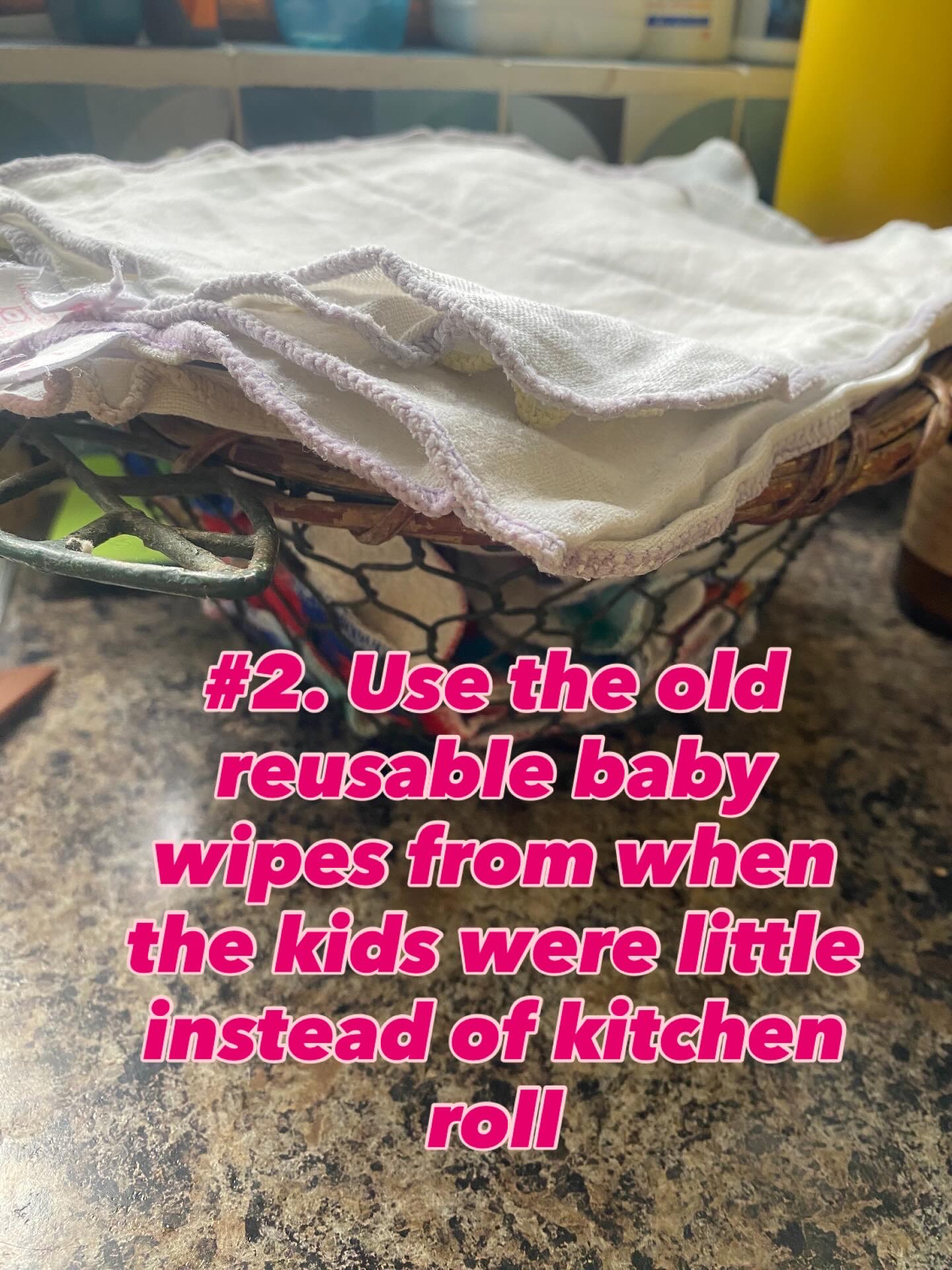
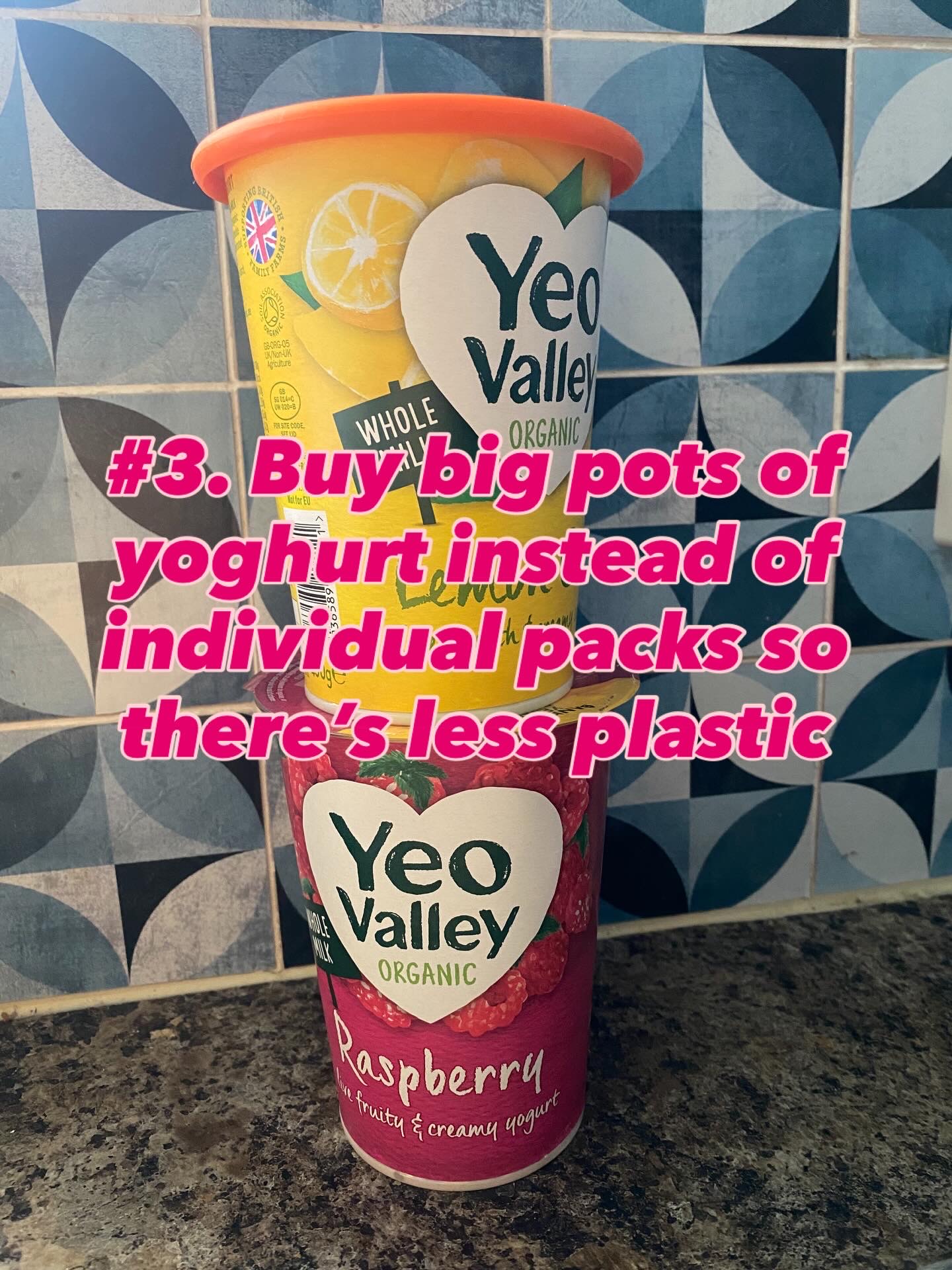
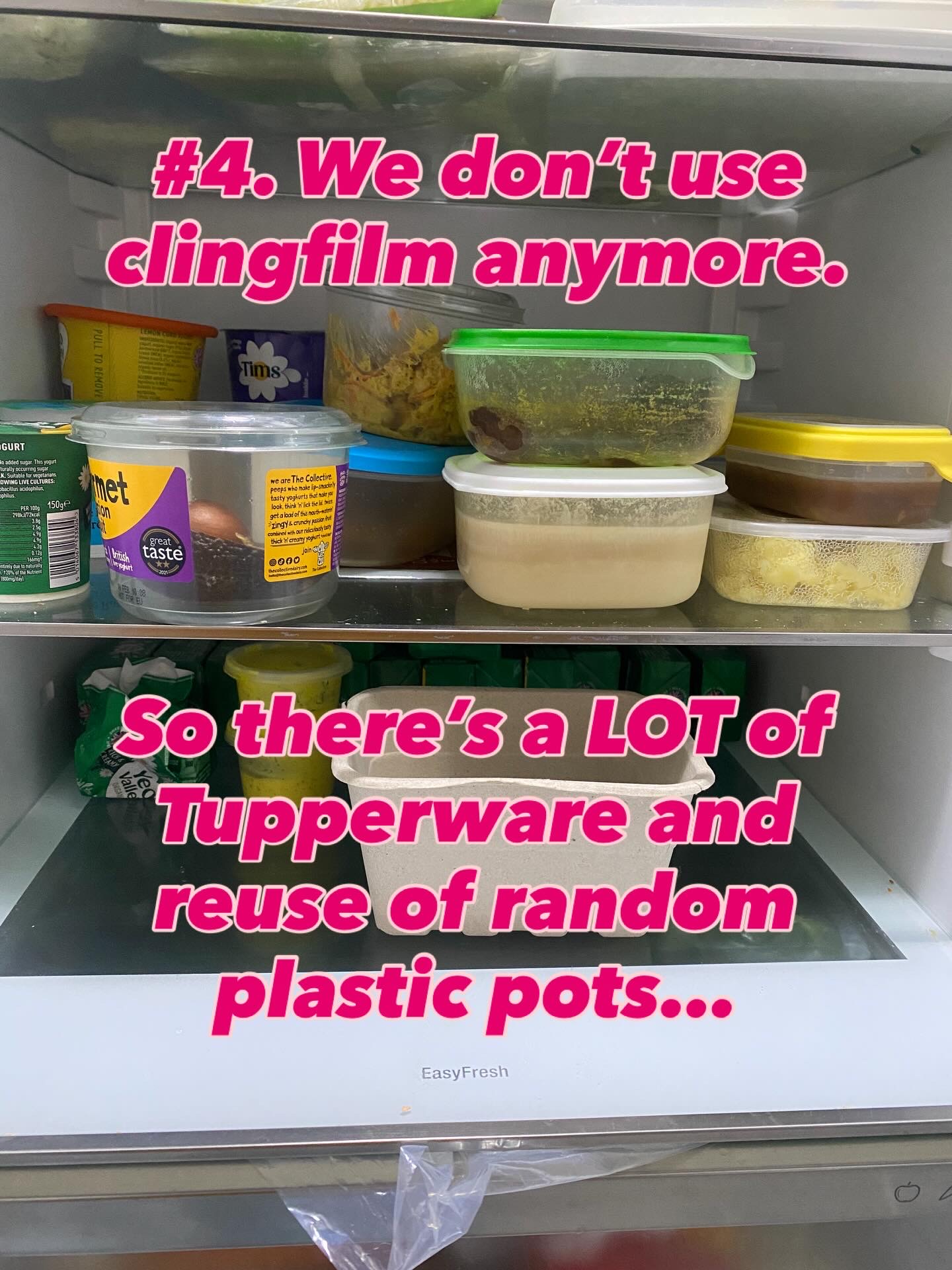
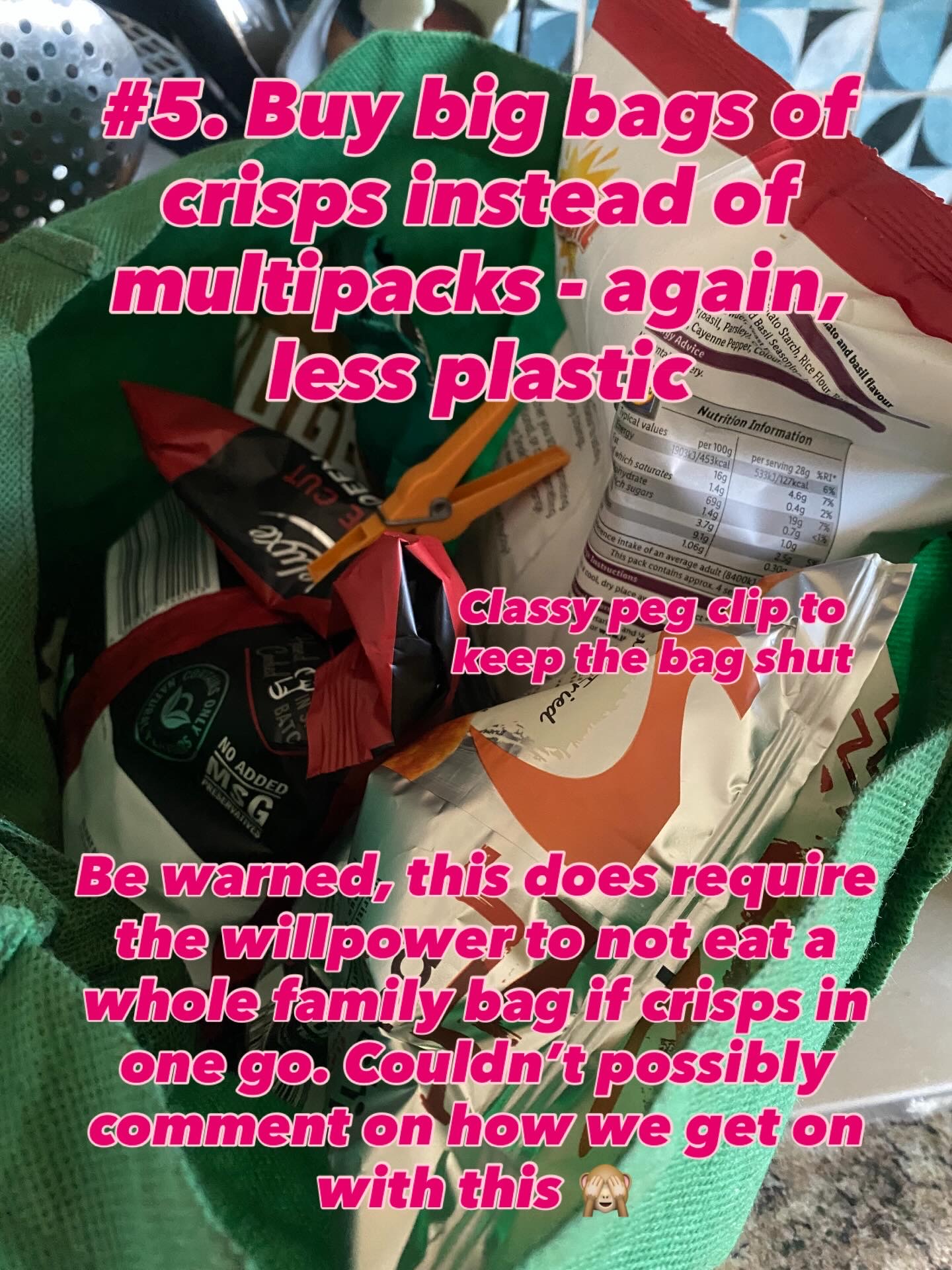
Five things we do that I forget aren’t ‘normal’..!


I shared these five things on Instagram and the post went a bit mad, getting over 60,000 views (way more than my stuff ever usually gets!).
So I figured it was probably worth saving them for posterity over here on the blog.

The context is, that there are Sustainable(ish) things that we do at home, that have become normal for us, so I don't really give them much thought. Until a 'normal person' comes round to our house, and then I'm suddenly reminded that they aren't really quite such normal things to do..!


Please say it's not just me!
Share your 'not normal normal things' below!

JOIN THE SUSTAINABLE(ISH) COMMUNITY!
Join over 6000 subscribers to the Sustainable(ish) weekly(ish) newsletter - get tips, ideas, and inspiration for imperfect eco-action, and all the Sustainable(ish) latest news, straight into your in-box!


Comparison-itis?


My goodness me, the internet can be an overwhelming place can't it? And that overwhelm perhaps reaches it's peak in January, when all the New Year vibes are high. It's very easy to spend a lot of time doom scrolling, looking despairingly at all the people, organisations and accounts absolutely smashing New Year challenges, comparing ourselves unfavourably, and leading to us feeling demoralised and deflated.

So if you too have yet to get round to that New Year fitness campaign/healthy eating plan/work project/challenge launch or anything else, remember this...

- There will ALWAYS be someone further ahead than you, doing 'better' than you (whatever metric you're choosing to measure by!), and appearing to absolutely smash it without breaking a sweat

- You have achieved so much already. Grab a pen and paper and start a list of all the awesome things you've already done - whether that's eco changes, or business projects, or getting up in the morning and getting the kids to school vaguely on time so far for the whole of the marathon month that is January.

- On social media we only get to see the shiny 'outside', not the messy, tear-stained, sweaty inside

- It's never too late to start.
F*ck January 1st. Any day is a good day to dive into something new. If you fancy it. But do it for you. And on your terms.

- "You do you babe".... Said tongue in cheek, but you know what I mean. Your 'amazing!' might be someone else's 'meh' and that's ok. Set your own goals, have your own ambitions, and if looking at what other people is doing is deflating you rather than inspiring you, look away (aka stop doom scrolling - note to self..!

Here ends my January TED talk.


Do you suffer from 'Comparison-itis'?Let me know in the comments!
 And do share any tried and tested techniques for tackling it!


Sustainable(ish) 2023 Review

It's been another busy year at Sustainable(ish) HQ (aka my house..!).
One of the things about being self-employed is that you don't get annual reviews and people giving you a pat on the back and saying 'good job'. It's very easy to constantly focus on the next thing, and all the things still on the to-do list, and very easy to quickly forget the progress that has been made, so I find it helpful to spend a bit of time looking back at the year and taking a minute to reflect and remember what I've done. 
This year, I'm going to share it here. It seems incredibly self-indulgent, so apologies in advance. Even if I'm the only one who ever reads it, it will make it easier to find to refer back to next year!


Carbon Literacy Training

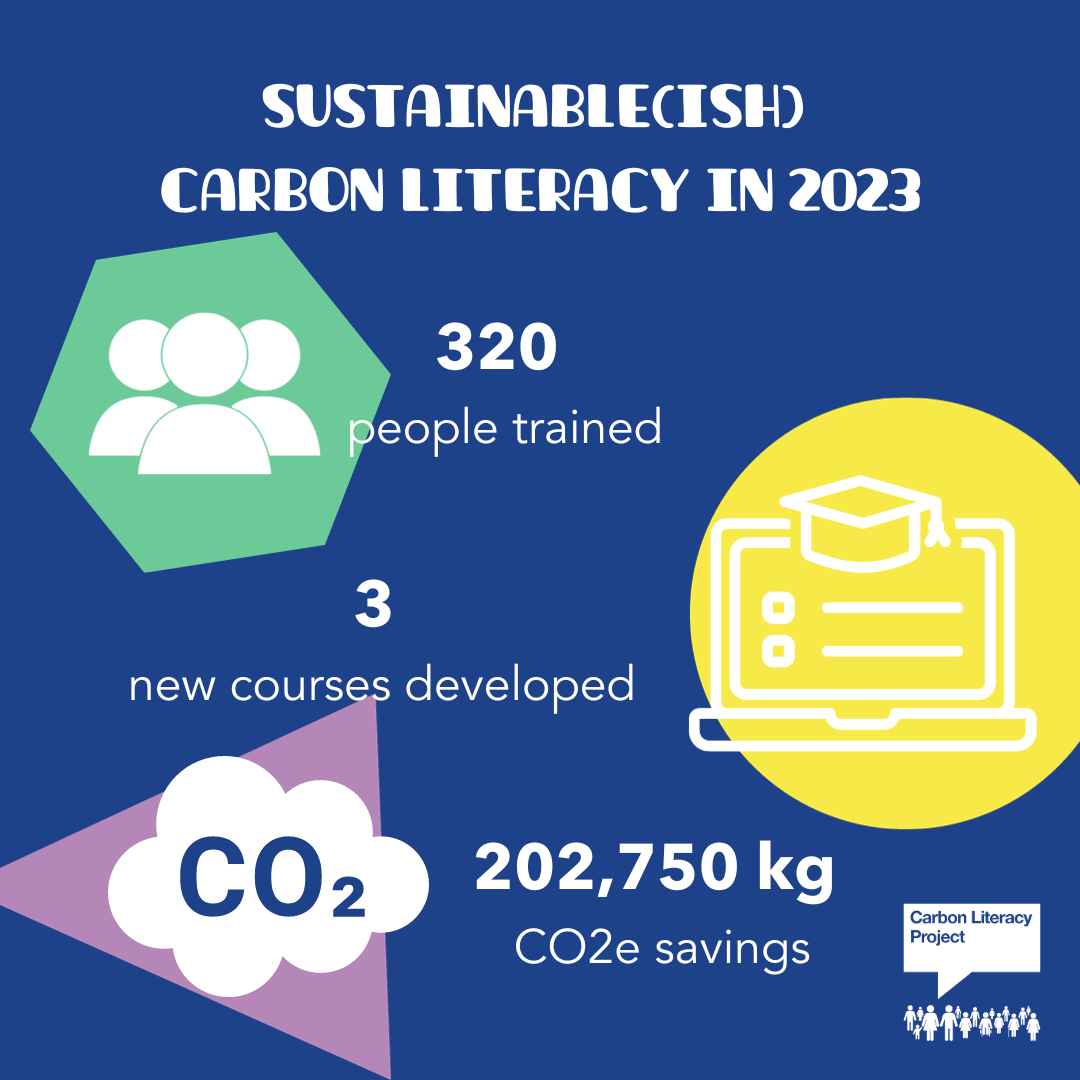
I can't tell you how much I enjoy delivering Carbon Literacy training - let's face it, 8hrs of 'sustainability' training doesn't sound like the most fun, and it is very much an emotional rollercoaster. But taking people on that journey and seeing their confidence in their own ability to create meaningful change is an absolute joy and and an honour (obviously I would much rather Carbon Literacy training wasn't necessary and we weren't in the midst of climate and ecological crises).
The numbers are...

  • Over 300 people trained
  • 3 new courses developed:

1) A collaboration with Vet Sustain to develop and deliver Carbon Literacy for the Veterinary Profession - we've had nearly 100 people take part in the course, from all over the world, and from a really wide range of roles within the profession. The collective emissions savings from the pledges are the equivalent to driving more than 12 times round the world!
2) A new course for Bloomsbury Publishing Plc - it was fabulous to have the opportunity to work with Bloomsbury to create a bespoke course for them, and to help them start to roll it out within the company
3) A course designed to help anyone who wants to create their own Carbon Literacy course for their community, workplace or sector - I piloted this in the summer, and am looking forwards to running it 'for real' in 2024.

  • Total CO2e savings of 202,750kg - the equivalent of over 40 return flights from Heathrow to Sydney

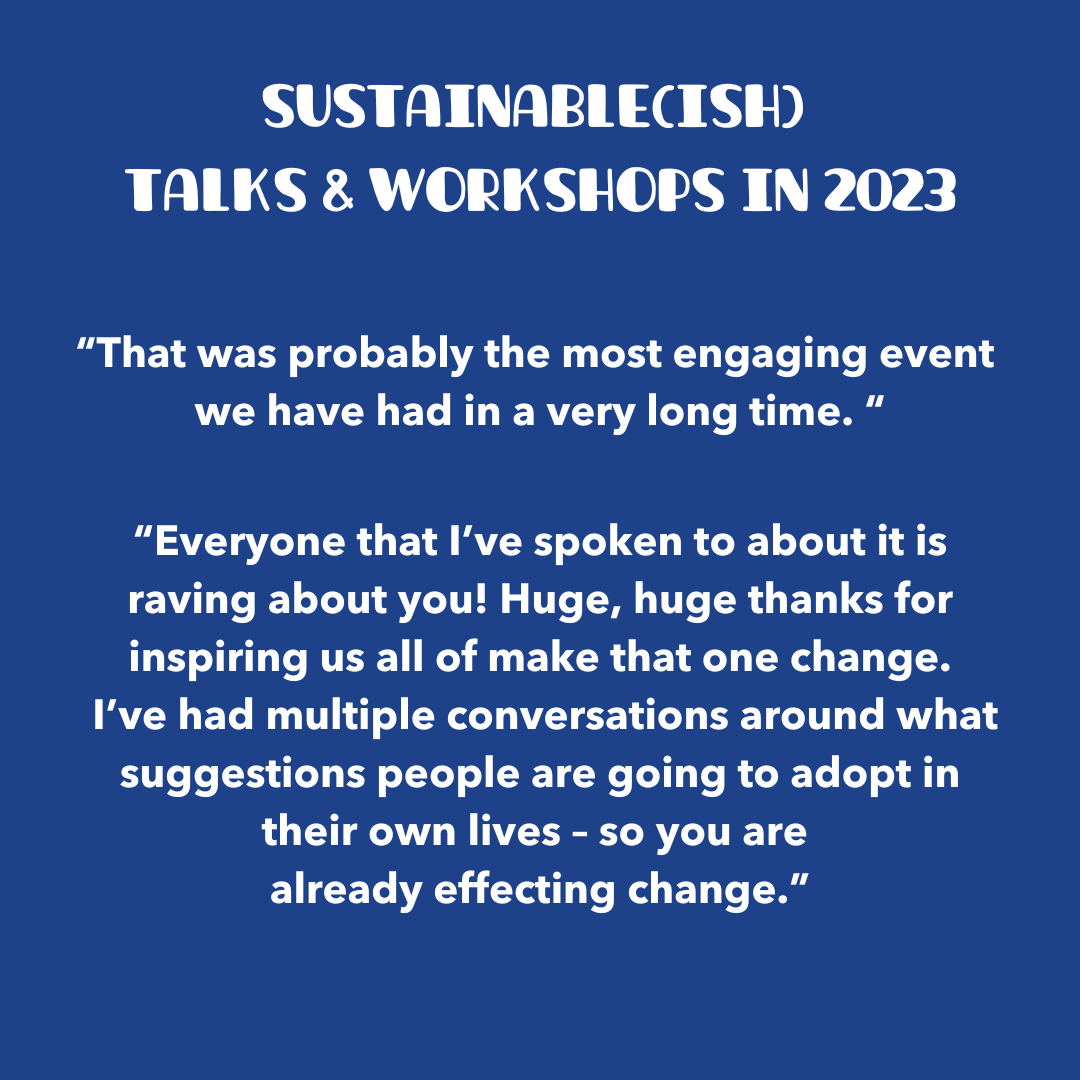
And so many lovely comments like this one here:
"I thought the two days were excellent, absolutely thought provoking, and pitched at a level which promotes genuinely possible behaviour change."

Have you done Carbon Literacy training this year?
Is it one of your 2024 goals?
There's dates for Jan, Feb, March and April here, and do get in touch if you're interested in developing a bespoke course for your organisation.


Speaking and workshops

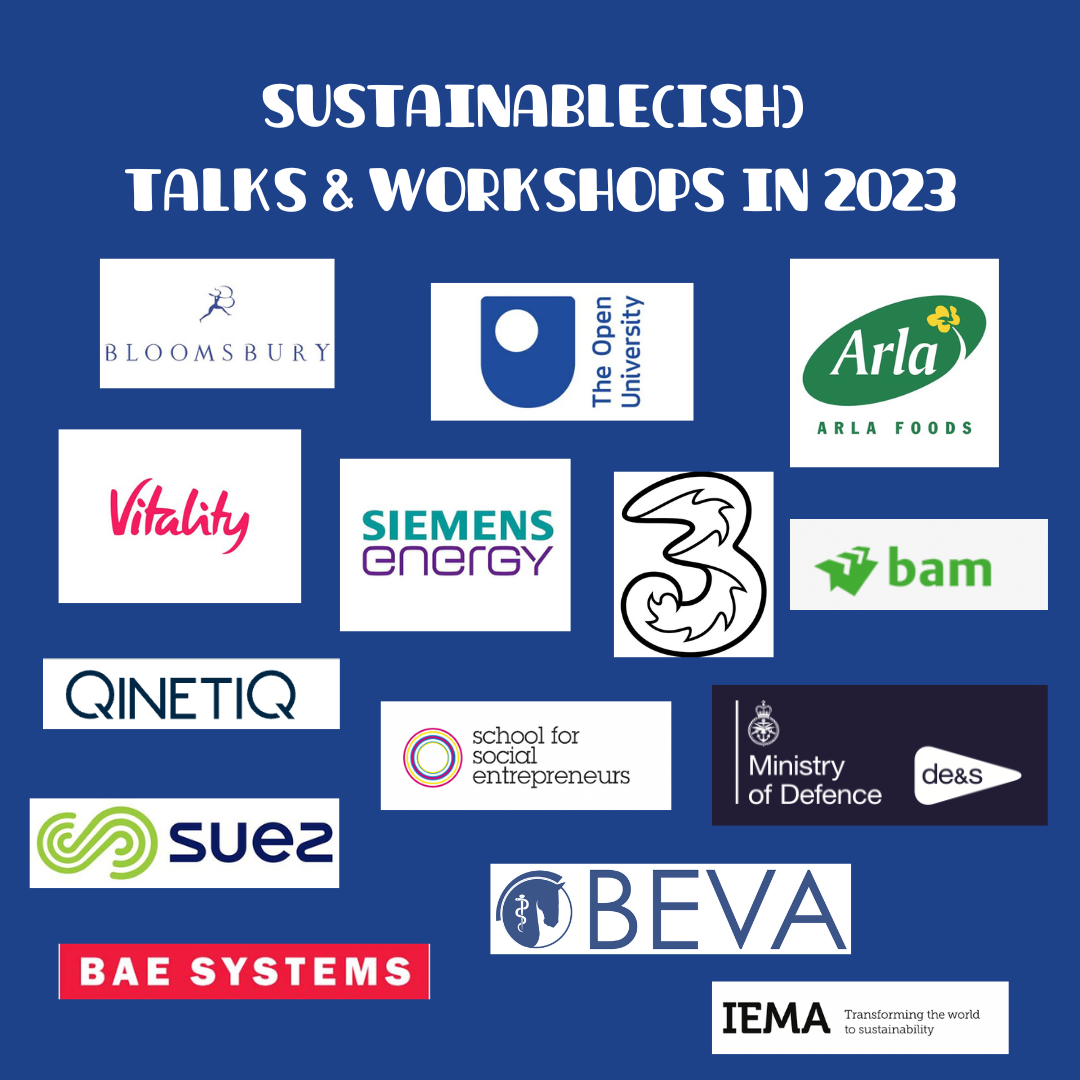
I've been fortunate enough to have the opportunity to deliver 35 different talks and workshops in 2023, from 'lunch and learn' sessions for big corporates and international conferences, through to evening talks for WI's as well as some sessions with schools.
I try very hard to make these sessions fun and light-hearted - no one really wants to give up their lunch hour to be bashed over the head with the big green bashy stick and told how awful they are! And to make sure that everyone leaves with at least one action they can take away -no matter how small. Hopefully these sessions sow the seeds and inspire more people to make a start, embrace the messy imperfections, and go on to make a bigger difference. 

Do drop me an e-mail (jen@sustainableish.co.uk) if you're interested in any talks or workshops for your organisation in 2024!


The Sustainable(ish) Clubhouse

Aka my favourite place to hang out on the internet!
47 amazing courageous tired eco-worriers joined the Clubhouse in 2023, swelling the numbers to over 160 in total.
Here's some numbers:

  • 6 'themes' covered throughout the year: Sustainable(ish) on a budget, food and gardening, travel and transport, waste and plastic, fashion, and self-care. And of course, we've had a good dollop of Christmas stuff at the end of the year!
  • Over 30 opportunities to jump on a call - whether that's a more formal webinar type call where I introduce the theme, the challenges and the ideas for action, an informal 'small group call' where we basically have a natter and a catch up, or a 'JFDI' (Just F*cking Do It) call where we log on and then go away and do something we've been putting off for ages and then come back and share how we got on!
  • Countless books read and reported on during our bookclub sessions
  • Amazing guest sessions from some of our wonderful members on 'getting recycling right' from Sarah, and 'buying and selling on Vinted' from the brilliant sustainable stylist Becky Barnes, and a brilliant video series on growing your own from Claire Brown at Plant Passion
  • We've played bingo, celebrated Sustainable(ish) wins, and also had a good old cathartic rant and a moan when things aren't going 'quite to plan'

The doors to the Sustainable(ish) Clubhouse will be opening again in January - you can sign up to the waitlist here if you'd love a bit of structure and support for a more sustainable 2024!


The Sustainable(ish) Podcast

After an unintentional break for most of 2023, I finally got the podcast back on it's feet in September, and 14 episodes have hit the airwaves this year. The podcast is hard work and takes a lot of time - it's a labour of love as I've failed spectacularly to 'monetise' it, but it does give me the opportunity to speak to so many amazing people who I wouldn't otherwise the opportunity to chat to!
This season we've had everyone from climate scientists (Climate Science 101 with Dr Adam Levy, and Debunking some climate myths with Dr Ella Gilbert) to amazing campaigners (Your council and climate action with Annie Pickering, and Badvertising with Leo Murray), as well as some brilliant 'ordinary people' who have stepped up and started extraordinary initiatives (Keeping outdoor kit in action for longer with Re-actionActive(ish) for Earth with Tash Acres, and The forgotten joy of sharing with Rebecca Heaps).
A massive thank you to all of my guests for so generously giving up their time to share their expertise and their brilliance and all the amazingly impactful stuff they're doing.

Download numbers put it in the top 10% of all podcasts globally, which feels a little bonkers, and it's almost made it into the top 100 science podcasts on iTunes (peaked at 107 - would be amazing to see it break through!). All of which feels pretty good for a tiny little independent podcast with no funding or sponsorship, and little old me doing all the work!

Thank you so much if you've listened, subscribed or reviewed.


Learning
There is always more to learn in the sustainability space and it's one of those things that the more you know, the more you realise you don't know! I've taken part in some great workshops and courses this year including:


Other stuff
And there's been a whole host of other stuff too! Including:

  • A LOT of posting on social media!
  • This e-mail list which goes out to over 5000 people - thank you for subscribing and for sticking around!
  • A 'new look' - thank you Lucie Gray Creative! 
  • The Crap-free Christmas course and webinar
  • Work with my local town council and my kids school
  • Volunteering for the Climate Emergency UK Council Climate Scorecards
  • Co-creating a 'Greener Veterinary Practice' modular course with Vet Sustain


None of this would have been possible without an 'audience' of people who care, who follow,
listen, read and most importantly take action.
Thank you so much for being here, for your lovely comments and e-mails and for being Sustainable(ish).
Here's to 2024!


Crap-free Christmas – wrapping with less waste

I genuinely can't remember the last time we bought any wrapping paper!
I'm a firm convert to fabric wrapping and have a stash of headscarves I've managed to find in charity shops, as well as a growing pile of fabric gift bags made from a Christmas duvet set I bought last year on Vinted. Honestly, this has transformed not only how full our recycling bin is in the New Year, but also how long it takes to wrap presents - SO quick and easy!

Here some other ideas for less waste wrapping!

PS. Bear in mind that whatever you're wrapping is probably a much higher impact than the wrapping paper, so making more thoughtful decisions about presents is also actively encouraged!


Buy recyclable paper
  • Avoid shiny metallic paper or any wrapping paper with glitter on it.
    Do the ‘scrunch test’ to see if it can be recycled:  Scrunch your wrapping paper up into a ball. If it stays scrunched it can be recycled (as long as it hasn't got glitter on it). If it starts to unfurl, it's probably got plastic or metal in it and can't be recycled.
    Remember to check with your local authority whether they will take wrapping paper - some local authorities won’t take any wrapping paper at all due to high levels of contamination (eg glitter, sellotape, metallic paper etc) and the fact that some wrapping papers are such poor quality and have very short fibres meaning they can’t be recycled.
  • Plain brown kraft paper can look really effective. You can even let the kids ‘tastefully decorate’ it (potato prints or cookie cutters dipped in water based paint works well) and it can still be recycled (avoid glitter!).
  • Use old newspapers and magazines. If you can bring yourself to do it(!) old sheet music or old maps can look beautiful.

Reusable wrapping 

If you get given gifts wrapped in non-recyclable paper (or indeed any wrapping paper!), channel your inner Nana and nab any big bits of paper as the unwrapping is taking place. A quiet half hour smoothing it all out and carefully peeling off the sellotape (I’m told that ironing it makes the tape peel off more easily) is surprisingly theraputic..!

Fabric wrapping is my new favourite thing. SO quick and easy!

  • Use charity shop headscarves for ‘furoshiki’
  • Nab a Christmas duvet from Vinted and make some fabric gift bags if you’re handy with a sewing machine
  • Check out ‘Wrag Wrap’ - gorgeous sheets of fabric gift wrap
  • Or search online for ‘reusable fabric gift bags’

What do you do for wrapping?
Have you tried/are you going to try Furoshiki? 
Do let me know!

INTRODUCING THE CRAP-FREE CHRISTMAS COURSE!

Join me and a merry band of similarly challenged Crap-free Christmas wannabees as we dive into into the nitty gritty, the practicalities and the emotional minefields of a festive season with less crap and more joy!


Crap-free Christmas – Christmas trees

"Oh Christmas tree, oh Christmas tree, what is the greenest ver-er-sion"** Sing to the tune of "Oh Christmas tree...!
There's way bigger things in life (and at Christmas) to stress over, but if you've found yourself wondering what the 'greenest' version of a Christmas tree is, here's some info!


Artificial Trees

The biggest impact from artificial trees comes from their production - they're made from metal and plastic, usually in a factory far away, so have significantly more 'embedded carbon' than a real tree.At the end of their life, they will simply sit in landfill for decades to come.
HOWEVER they can be used for decades!

 **It's estimated that you need to use an artificial tree for at least 10 years before it has a lower environmental impact than a natural tree.**


Real trees

Real trees obviously absorb CO2 as they're growing, so their 'embedded carbon' footprint is much lower than an artificial tree. However there can be emissions associated with transporting it, so finding a local grower is a good idea.
The biggest impact from real trees, comes from their disposal - the worst case scenario being landfill where they will rot and release methane (a potent greenhouse gas).


The 'gold standard' is to get a tree with a root ball that you can plant out and then re-use each year, however not everyone has the space (or the green fingers!) for this.


RENTAL TREES
Depending on where you live, you might be able to rent a real Christmas tree!
You can go and pick your tree, it arrives, in a pot with it's root intact. You decorate it and look after it over Christmas. Then the company come and collect it, plant it out again, ready to do the whole thing again next year!


Upcycled trees

Something as simple as a ‘festive branch’ can work really well and look amazing. For less traditional ideas, Pinterest is your friend, and you will find all kinds of creative ideas.
The 'pros' for upcycled trees are: 

  • Re-using something that might otherwise end up as waste
  • Unleashes' your creativity!
  • Can be used again and again

But there is a major caveat in that they may cause tears if Pinterest aspirations not met...!
Here are some that we’ve tried over the years...


What are you doing for your Christmas tree?
And which is your favourite of our upcycled trees?!
Do let me know!

INTRODUCING THE CRAP-FREE CHRISTMAS COURSE!

Join me and a merry band of similarly challenged Crap-free Christmas wannabees as we dive into into the nitty gritty, the practicalities and the emotional minefields of a festive season with less crap and more joy!


#CitizenFriday

I'm absolutely loving the 'Citizen Friday' campaign from the very brilliant Gavin Fernie-Jones and Heather Davies at Re-Action..
Re-Action Collective is all about encouraging people to become citizens not consumers (you can hear more about the brilliant stuff they do on the podcast here). And for #CitizenFriday they want us to be 'citizen-ING', instead of shopping, "using our agency as humans to connect with each other."
Gavin says: "Citizen Friday is about sharing skills, learning crafts, swapping items, building community and reconnecting with the natural world. It’s about using the power of the individual for the collective good."

There are 3 elements to #CitizenFriday:
Share, Repair, Get out in the fresh air,

I love this campaign! The idea of re-claiming a day that celebrates consumption and excess and 'more' with a call to stop and slow down and re-connect with ourselves, our communities and our beautiful world.
So how about it?
Are you up for swapping shopping for a spot of 'citizen-ING'?

  • You could list your tent on Tent Share (you can hear more about Tent Share via this episode of the podcast here) or share something you no longer want or need on OIio or Freegle or your local Buy Nothing  group.
  • You could tackle one item out of your mending pile, or if you're a mending newbie, just pick one thing and have a go! Head to Repair What You Wear for loads of brilliant resources, or see if there's a Repair Café UK happening locally to you this weekend.
  • You could go for a walk, a jog, a bike or simply a gentle wander. Could you walk (part of) the school run or your commute today? Or get outside for 20 minutes at lunchtime.
    And while you're out there, if you need a gentle hand 'connecting with nature', I would highly recommend the Seek app to help you ID plants, animals and insects, and the Merlin Bird ID app to help you ID birds from their songs. Yes, very aware of the irony of recommending apps to help us connect to nature!

Do let me know what you get up to today!
Let's see if we can flood the interweb with enough tales of citizen-ing to drown out the Black Friday ads!


Crap-free Christmas – alternative Advent Calendars

Depending on what you do, Advent calendars can be as low impact as last year's cardboard version with the doors stuck back down a la the 1980's, or plastic tat-tastic if you've been sucked into the idea that the kids should get a small thing each day (guilty as charged).

Here are a few ideas for Advent Calendars with less waste, less stuff and more of a focus on giving and doing:


"Advent-ure" calendar 

(totally stole this word from one of the Clubhouse members!)
Aka Christmas-y things to do each day.
 
Instead of a chocolate or some plastic tat, pop in a slip of paper with a 'thing to do together' each day. This is a nice way of starting to try and shift the focus of your Christmas from 'stuff' to 'time spent together'.
Depending on the ages of your kids this could be things like "make mince pies", "star in your school nativity play", "visit the library to choose some Christmas books", "snuggle up and watch a Christmas movie"...

There's a whole printable list of ideas in the Crap-free Christmas course.


Acts of Kindness calendar 

Similar to the above, but your slip of paper has suggestions for Random Acts of Kindness eg "send a card to the local nursing home" or "take some mince pies to a neighbour" etc

Reverse Advent calendar 

Pop an item for the foodbank into a box each day (you might want to drop this off at the foodbank before Christmas eve to give them time to get it to those who need it)


Homemade Lego or jigsaw Advent Calendar 

Fran in the Sustainable(ish) Clubhouse does her own homemade Lego version with a secondhand set from Vinted, putting in the right pieces for each instruction in the set each day. And I've seen other people break up a jigsaw puzzle to do together.

Photos from the year 

I do this for my husband! I scroll back through our photos on our phones from the year, and get a selection printed out. Pop one a day into a numbered envelope and jumble them up. The idea is then to put them into an album come the New Year (we always fail miserably to do this...)


What are you doing Advent Calendar wise this year?

INTRODUCING THE CRAP-FREE CHRISTMAS COURSE!

Join me and a merry band of similarly challenged Crap-free Christmas wannabees as we dive into into the nitty gritty, the practicalities and the emotional minefields of a festive season with less crap and more joy!


Sparking Joy!

(No, don't worry I'm not going to make you organise your sock drawer ala Marie Kondo...)

One of the things that I don't think we're good enough at doing in the climate space is communicating just how much better things could be, if we get this transition right.
The climate narrative in the media is focussed on the problems in terms of extreme weather events and their solutions, and then when solutions are discussed the framing is often focussed on the things that will be taken away: 'They're coming for your cars, your holidays, your burgers. Oh, and by the way you'll have to find space for 7 bins.'
The picture that is painted is of a grey, austere life, where all the joy has been sucked out of life by the bureaucratic tree hugging (pretty sure that's an oxymoron) greenies, who want to deprive you of all the things you enjoy.
And that's just not the case.
There is SO MUCH JOY to be found in making more sustainable choices!
And we need to celebrate them and get better at shouting about them.

To quote Louisa Ziane from Toast Ale “To change the world, you’ve got to throw a better party than those destroying it.”

Look for the joy.
Really notice those moments - tiny everyday moments through to big old life changers.
Notice the joy.

Here's a couple of examples I heard just in the last couple of days:
- Mel in The Sustainable(ish) Clubhouse shared how she went to the bakery and got chatting to a lady, telling her about the things she saw out of the train window on a recent trip to France, and the lady said that sounds like a wonderful way to travel and she's putting it on her bucket list!
Someone followed up on the same thread with the comment "The flamingoes from the train in France!". Come on now, who isn't now wanting to jump straight on that train?
- Nikki on my Carbon Literacy course last night talked about the joy (and she literally used that word!) she feels when she opens the front door in the morning to collect her milk, freshly delivered in glass bottles by her local milkman!

Not only is this a much more inspiring and inviting narrative, it's so much better for our own mental health too. Once you know about the state of the planet you can't unknow it, and you can't not make the changes, but challenging the status quo of a society and media obsessed with more can just occasionally feel a teensy bit challenging..!

So, how about if we re-framed it?
We're going to do this stuff because we simply can't not. Let's see how much fun we can have and joy we can find along the way!


What do you reckon?
How has making more sustainable choices sparked joy for you?
Do share!
Let's create a joy-filled thread of stories that shift the narrative,
and get people excited about joining our party!

JOIN THE SUSTAINABLE(ISH) COMMUNITY!
Join over 6000 subscribers to the Sustainable(ish) weekly(ish) newsletter - get tips, ideas, and inspiration for imperfect eco-action, and all the Sustainable(ish) latest news, straight into your in-box!

1 2 3 13