I'm delighted to be working with Organic UK* for a mini-series of podcast episodes to mark Organic September - an annual month long awareness campaign by the Soil Association In collaboration with the Organic Trade Board.
Now I’ve been buying organic food for a while now – we get a weekly Riverford veg box, and I seek out organic products in the supermarket whenever I can. But until recording this series I wasn’t really that aware of the huge potential impact that organic systems can have on the climate crisis.
Agriculture and food production get a bad rap when it comes to the climate – agriculture is responsible for 9% of all Greenhouse Gas emissions in the UK. Together with related emissions from changing land use and cutting down forests, it accounts for around 30% of greenhouse gas emissions globally. BUT research by the The Soil Association shows that if Europe’s farmland all followed organic principles, agricultural emissions could drop by 40-50% by 2050. That's a massive chunk of carbon saved right there.
So how does this work? What is it about organic practices that means they pump out so much less carbon?
Well I’m glad you asked!

In this episode I’ve got a two parter for you – in the first part I’m chatting to the wonderful Anna de la Vega from The Urban Worm who some of you may remember from episode 38 where she answered all my questions about wormeries. In this episode she’s sharing her knowledge about soil health, why it’s so vital to the planet, why modern agriculture is so bad for it, and how organic systems can help to replenish it.
And then in Part 2 I’m chatting to Tim Mead, dairy farmer and owner of Yeo Valley, about how organic and regenerative agriculture works in practice on their farm and what they’ve achieved in terms of reducing their carbon footprint.
It’s a fascinating episode, a total eye opener for me – I think I say the words ‘mind blown' at least 57 times…
Enjoy!
* This is a paid partnership with Organic UK.
Podcast: Play in new window | Download
This episode was edited by Emily Crosby Media
Useful links
- Organic UK
-
A BEGINNERS GUIDE TO SUSTAINABLE EATING
In the same way that 'sustainability' and 'sustainable living' will mean different things to different people, 'sustainable eating' will too.
For some people it will be all about veganism and plant-based foods, for others it will be about plastic packaging, or local, or fairtrade, or organic.
The debate around food has a teeny tiny tendency to become very polarising, especially when discussing veganism, which is something I'm really keen to avoid. There is no doubt at all that we all need to reduce our consumption of meat and dairy products, for our own health, and for the planets, but as with all things Sustainable(ish), there is space for nuance. When it comes to the climate crisis and the health of the planet, yes, it's about WHAT we're eating, but it's also about HOW it's been produced as well. As well as carbon footprints we also need to look at soil health, biodiversity and bio-abundance to name just a few things.
It would be really lovely to be able to say "do x, y and z" and I guarantee you you're doing the best thing for the planet. I think that's what all of us want really isn't it? Someone to come along and give us definitive answers. But sadly, frustratingly, there aren't that many definitive answers. Some of it will depend on your own personal values hierarchy.
This isn't a definitive guide. I'm not a climate scientist. Or an ecologist. Or any other kind of -ist.
It's a beginners guide - enough to tickle your tastebuds (see what I did there), give you some 'headline' facts and figures, and then if you're so inclined you can toddle off and do a little extra research. But this should be enough to at least get you started!
1. Reduce food waste
According to Project Drawdown (an in-depth dive into the 100 most effective solutions to reverse climate change) reducing food waste is ranked 3rd. At numbers 1 and 2 are refrigeration and onshore turbines respectively, and whilst I can use my voice to lobby for policy changes in both those areas, it doesn't feel like it's something we can directly impact as individuals and families.
Food waste on the other hand is something we can all get behind.
Food waste on the other hand is something we can all get behind.
If food waste were a country it would be the 3rd biggest emitter of greenhouse gases after the USA and China.
50% of food waste occurs in the home. My home. Your home. All of our homes.
So it's a big impact thing we can all do something about - yay!
Here's 3 top tips:
Here's 3 top tips:
- Do a meal plan - it doesn't have to be anything fancy, but plan ahead for what you're going to eat and when. It sounds dull and boring (because in all honesty it is) but it will cut down your food waste AND save you some cash
- Implement an 'eat me first' box or shelf in your fridge. Then tell everyone in your house they have to eat what's there before they open yet another pot of yoghurt.
- Love your leftovers. Get inventive with your leftovers - turn leftover rice into stir-fried rice, chop leftover pasta into a frittata, blitz up the cauliflower cheese the kids point blank refused to eat into soup (they will eat it. Or at least mine did...)
2. Choose organic
I kind of knew that organic was 'a bit better' for the planet but until I did a mini-series for the podcast with Organic UK, I didn't realise really quite how much better.
Fewer pesticides means that the health of the soil is maintained far more easily, meaning that less fertiliser is needed, greater biodiversity, as well as more carbon sequestered into the soil.
I had no idea about the concept of 'regenerative agriculture' until I recorded the Organic Food and Climate Change episode, but what I learned really blew my mind.
If all of Europe's farmland followed organic principles, emissions from agriculture would drop by 40-50%
Organic soils are 25% more effective in storing carbon on the long-term
Here's some ways to incorporate organic into your diet:
- Get a veg box - look for a local supplier, or check out schemes like Riverford and Abel&Cole
- Can you go 50:50 organic:normal with your milk. Or do like one person did on one of my courses and get a pint less a week, but get organic (so she now gets 5 pints of organic, instead of 6 pints of regular)
- Pick ONE thing to swap for an organic version in your next shop - whether that's fruit and veg, or baked beans, or chocolate, keep your eye out for the logos and make a swap!
3. Eat the seasons
With everything we want available in the supermarkets whenever we want it, it's really easy to lose touch with what's in season. I think we probably all know the obvious ones like strawberries and raspberries, but I have to confess I'd probably struggle if I was pushed beyond that.
The problem is, that when we eat fruit and veg out of it's normal growing season here in the UK (or at least in Europe), it probably means it's been shipped halfway around the world to arrive on our plates.
An air-freighted punnet of strawberries has almost the same carbon footprint (1.8kgCO2) as a raw steak (2kg).
1kg of organic cherry tomatoes grown in the UK in March will have a carbon footprint of 50kg CO2 due to the need for heating of greenhouses.
A 250g pack of local seasonal asparagus has a carbon footprint of 125g of CO2. That same pack air-freighted to the UK from Peru in January has a carbon footprint of 3.5kg (28x greater)!!
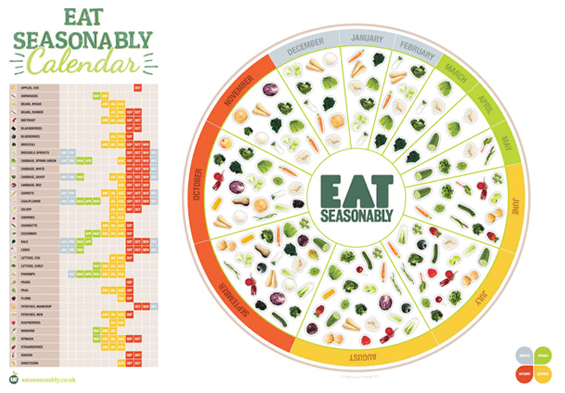
You can find lots of 'eat the seasons' calendars online, including the one below from Eat Seasonably, which you can get as a poster (to pin to your fridge?) and even a tea towel!
My cheat's way of eating seasonally is to get an organic fruit and veg box - if it's not in season, it's not in there, and I don't even have to think about it!
4. Eat more plants
In early 2019 a group of over 30 world-leading scientists from around the globe got together to create a consensus on a diet that was healthy, and sustainable - capable of feeding 10 billion people (expected global population by 2050), that would minimise greenhouse gas emissions, prevent any species going extinct, have no expansion of farmland, and preserve water. Not asking much hey...?
The headline figures they came up with are:
- 100g red meat a week
- 200g chicken a week
- 250ml milk a day
- 200g fish a week
- 1 egg a week
- The majority of our protein should come from pulses and beans - 500g a week
Now there's a distinct lack of cake in that diet for my liking, and I have to confess that we are a long way from the climate ideal in our house but it does go to show what we should be aiming for.
Here are some tips for upping the plants, pulses and beans in your diet:
- Reduce the meat in stews and things like bolognese, and make the rest up with some red or green lentils. I promise you no-one will even notice the difference.
- Try Meat Free Monday (or Tuesday, or Friday - it doesn't really matter..). If you're already nailing that, then can you do 5:2 - 5 days with meat and 2 without, or even 5 days veggie/vegan and 2 days with meat meals?
- Can you go for a plant based lunch? Beans on toast and soup are really easy veggie/vegan options that usually get scoffed in our house!
5. Go plastic-free(ish)
I'm going to start off by saying that I think packaging on food is one of the hardest things to tackle in our homes. I always suggest people start off with some easier bits first, like reusable water bottles and coffee cups, and then look at the bathroom. Some packaging is genuinely helpful in extending the shelf-life of produce (shrink-wrapped cucumbers can prevent waste by up to 2/3), some is needed to protect the product (eg soft fruit) and some is there for the convenience of the supermarkets and consumers.
Sometimes it can feel like trying to figure out the lesser of two evils if we're in the supermarket - organic fruit and veg will often be packaged in plastic in order to differentiate it from the conventional produce, which is a little, shall we say, frustrating..!
If you're like most of us, and stuck with a weekly mad dash around the supermarket, keep your eye out for plastic-free foods - they are there! Porridge oats, and even pasta are now becoming more widely available in cardboard and paper bags. I've got a post here with lots of hints and tips for plastic-free shopping at the supermarket.
Here are some other tips:
- Getting a fruit and veg box will help to massively cut the volume of plastic entering your home, and allows the win-win of organic and plastic-free! If you're on a budget, remember it doesn't have to be all or nothing - can you get a veg box once a month? This would reduce your plastic use by around 25%!
- Check out Zero Waste Near Me to find your nearest zero waste store where you can take your own containers to fill up with all kinds of storecupboard staples, from pasta and rice, to dried fruit. Again, it doesn't have to be all or nothing - if you can visit once a month or every other month and stock up, and then revert back to packaged produce until you can go again, that is absolutely still a Good Thing!
- Go big...! Buy the biggest pack of something and then divide it out at home. For example, we buy the share bags of crisps, and simply pop a handful into a compartment in lunchboxes. We also get the 500g pots of yoghurt and use reusable pouches for the kids to take some to school.
If you want more tips for eating sustainably, check out Episode 74 of the podcast:

What does 'sustainable eating' look like to you?
Let me know in the comments!
[074] SUSTAINABLE EATING
I'm delighted to be working with Organic UK* for a mini-series of podcast episodes to mark Organic September - an annual month long awareness campaign by the Soil Association In collaboration with the Organic Trade Board.
In the same way that 'sustainability' and 'sustainable living' mean different things to different people, 'sustainable eating' will too. With that in mind, we've collated a brilliant panel to discuss what it means to them, the impacts our choices around food have on the planet, and how we as individuals and families can take some simple steps to eat more sustainably.
Our brilliant panel comprises Melissa Hemsley – self taught cook and author of a stack (technical publishing term..) of amazing cookbooks including her latest Eat Green – based on the 15 most commonly thrown away foods; Ben White from Coombe Farm Organic - an organic farm in Somerset breeding and rearing slow-growing native breeds to produce award-winning meat; and Tim Field, head of sustainability at Daylesford – one of the most sustainable farms in the UK.
Enjoy!
* This is a paid partnership with Organic UK.
Podcast: Play in new window | Download
This episode was edited by Emily Crosby Media
Useful links
- Organic UK
-
A BEGINNERS GUIDE TO ORGANIC
What exactly is 'organic'?
We're all pretty used now to seeing the label on some of the foods on our supermarket shelves, and maybe even on our beauty products or even some of our clothes. But what does it really mean?
If pushed, I'm guessing most of us would say "something to with pesticides" perhaps, and if asked why we choose organic (if we do) we might say that we think it's better for us. But is this true?
To celebrate and promote #OrganicSeptember I've teamed up with Organic UK* to create a mini-series of podcast episodes and blog posts delving a bit deeper into all things organic. In this post, I'm going to try to answer some of the most commonly asked questions, and create a kind of 'beginners guide' to organic.
This is a bit of an epic post. But it's a bit of an epic topic. I hope it's helpful!
* This is a paid promotion with Organic UK
1. What is organic?
The word 'organic' has lots of different meanings, and even the various online dictionaries that I looked at had different definitions, mainly focussing on the fact that pesticides aren't used:

Collins Dictionary

Cambridge Dictionary

Merriam-Webster (Have to be honest, not a clue what this really says...)
The Soil Association is a charity that campaigns for good food for all, produced with care for the natural world, it also has standards for organic food and drink that the majority of food / drink sold in the UK are certified to, and on their "What is organic?" page, this is what they say:
"Organic is a system of farming and food production that aims to produce sufficient quantities of high-quality food. This is done using methods that deliver a breadth of benefits across our whole food system, from people to planet, plant health to animal welfare."
In the Organic 101 podcast episode Lee Holdstock, Trade Development Manager at Soil Association Certification came up with this:
"Organic is a method of agriculture, a way of farming. Working with nature. It's stewardship. Handing over the land to our children and grandchildren in a fit state. It's about taking responsibility."
Now I feel like we're getting somewhere! It sounds a bit like what many of us are trying to in our own lives.
Going back to The Soil Association website, they list a number of principles:
2. Is organic a legal definition?
Yes! The good news is it's EU law (since 1991) that for a product to be labelled 'organic' it must be certified and meet a minimum set of standards. If you're a super keen-bean you can check out what those EU standards are here.
3. What logos and badges should we be looking out for?
Food labelling can be confusing, and there are a plethora of different badges and logos around. If you're knee deep in the supermarket shop with a screaming toddler in the trolley, the good news is that there are a couple of key logos to keep your eye for:
The EU organic logo - all organic food sold in the UK must meet the EU regulations in order to display this badge. Don't even ask about Brexit.

EU organic logo
The Biodynamic Association are another organisation supporting producers, and providing organic certification, which you can read more about here.

The Biodynamic Association Certification
The Soil Association is the UK's largest and oldest certification body and licenses over 70% of the organic produce for sale here in the UK. And they have higher (read stricter) standards over and above the EU ones, which you can check out here. You will undoubtedly have seen their logo around, but maybe not realised exactly what it means.

Soil Association logo
Organic Farmers and Growers (OF&G) certify over 30% of the UK organic sector, so is another logo to keep your eyes out for.

Organic Farmers and Growers logo
4. What are the benefits of organic?
Perhaps unsurprisingly, I'm going to say 'lots!', and I'll briefly outline them below. But one thing I really want to highlight that I don't think I had quite grasped before, is the huge benefit that organic has when it comes to the climate crisis. Soil stores carbon within it, and healthy soil is able to lock more carbon away. The vast majority of artificial fertilisers are fossil fuel based potentially giving our food a hefty carbon footprint before it's even left the farm to make it's way to the supermarket shelves. Routine use of pesticides kills off not only the 'pests' but also the beneficial insects as well, and as we heard in Episode 72 of the Sustainable(ish) podcast with Buckley's Bees, insect populations are crashing, having knock on effects on the ecosystems they inhabit, as well as a potentially catastrophic impact on how we farm.
One of the things I bang on about a lot, is the power of the choices that we make. When we're choosing organic, I think it's fair to say we're making a choice for the planet. For the health of our soils, our wildlife and nature, and for future generations.
Here's that list of benefits I promised:
- Better for the planet
According to the website Farm Carbon Toolkit, agriculture is responsible for 9% of all Greenhouse Gas emissions in the UK. Together with related emissions from changing land use and cutting down forests, it accounts for around 30% of GHG emissions globally. The Soil Association's research shows that if Europe’s farmland all followed organic principles, agricultural emissions could drop by 40-50% by 2050. That's a massive chunk of carbon saved right there. - Higher welfare for livestock
The Soil Association's standards for animal welfare are the highest of any certification in the UK - you can take a look at them here. - Better for nature and wildlife
Organic farming uses far fewer pesticides meaning that there is around 50% more plants and insects on organic farms, and 75% more wild bees. - Better for our own health
The routine use of pesticides and antibiotics in many conventional farming systems can mean that residues can be present in the food that we eat. Choosing organic hugely limits (eliminates?) the amount of chemicals that we are unwittingly ingesting.
There's lots more info on the benefits of organic on The Soil Association website here.
5. Can organic feed the world?
There is an argument that to feed a growing global population that we need to keep pushing for higher and higher yields, and that farming organically would mean that we wouldn't have enough food (yields can sometimes be lower).
Conventional farming has weakened the soil - when I interviewed Anna at The Urban Worm she blew me away when she told me that here in the UK we only have around 30-40 years of healthy soil left. And the poorer the soil becomes, the lower the yields will be, and the more artificial fertilisers we need - it's a vicious cycle from which it will be very difficult to recover.
30% of all food produced is wasted. And 30% of the global population is clinically obese. So really, what we're looking at as the population grows, isn't a problem of volume of food - it's more about the quality of the food, and distributing it effectively.
If we're able to shift farming practices to ones that preserve soil health, produce better quality food, and reduce food waste, we'd go a long way to being able to feed the world without wrecking it.
6. Why is organic often more expensive?
There may well be people reading this, thinking "that all sounds great, and I would love to choose more organic, but I'm on a budget and organic is often more expensive".
This is such a complex area, and we touched on this a bit in the Organic 101 podcast, talking about the fact that in the same way that the price for 'fast fashion' comes is the cost to the people working in the industry and the planet, the price for highly intensive, processed food is to the planet, and that we aren't seeing the 'true cost' of food production reflected in the prices we pay.
There's so more info here from Clare McDermott at Soil Association Certification:
- Smaller volumes / diseconomies of scale
The organic market is (still) only 1.6% of total food and drink – that’s quite small despite it growing rapidly. And that means it doesn’t reach the large economies of scale that you can achieve with non-organic. That might be at growing level (where actually yields and return are higher often for organic) through having smaller manufacturing runs in factories to having to keep production lines separate. The cost comes down when you get bigger volumes and dairy, for example, which has a higher penetration and market share (more people buy organic dairy) is nearer in price to non-organic. - Higher labour costs
Economies of scale come into this again - it's harder to pick a small field of carrots than a large one. There are some areas where its more labour intensive and less mechanised and there is also more hands on management. - Pricing decisions by retailers
This one is key as non-organic food will often be on promotion. These promotions don't reflect the true cost of production and makes the organic differential look really large. Organic food will also be on promotion, but less so as it is seen as a value add line for them. This is especially true of products like milk, which many supermarkets us a loss leader to get people through the doors.
Ultimately we need to decide on how we feel about a cheap food culture which is coming to the forefront of the debate currently, alongside do we want to pay more for food that has a benefit to the environment.
7. Why is organic fruit and veg in the supermarket usually packaged in single use plastic?
It's SO frustrating isn't it? We're trying so hard to do the right thing - we're looking for organic produce, and we're looking for loose fruit and veg because we're trying to reduce our plastic footprint, and it feels like we have to make a choice. We can have one or the other, but not both. Why?!!
I asked this question in the Organic 101 podcast, and Guy Singh-Watson from Riverford explained that it's often for the convenience of the retailers. When you have conventional apples next to organic ones, and the organic ones cost more (see points above for why!) there needs to be some way of distinguishing between them. The packaging also provides a way for the retailer to give you the information you need about the organic product, eg certification etc. Do have a closer look at the packaging though, as many retailers are making changes to introduce things like home compostable and recyclable versions.
Yes, it's hugely frustrating. One option to think about is to look into local veg box delivery schemes. These will often be organic and come with substantially less packaging - I really notice the difference in our bin if I forget to order our fruit and veg box!
8. How can we as consumers help to push for more organic products and practices?
AKA How can I be organic(ish)...?
- Buy organic if and where you can!
Organic UK are running a 'Power of One' campaign, encouraging consumers (us) to swap out regular item for an organic one in their weekly shop. Remember, that as with all things Sustainable(ish) it's not all-or-nothing. Can you get a veg box once a month? Or every other week? Can you go 50:50 on your milk? Shop with the seasons - when it's in season, fresh, local organic produce will often be cheaper/comparable to conventional. - Share the choices that you're making
If you join in with the Power of One campaign, there's some lovely graphics you can share on social media. If you make a swap, share it! If you've found out some stuff from this (mammoth) post or the podcast series, share your favourite stats and the changes that they've inspired - start a conversation! - Lobby your supermarkets
If you want organic produce and their range is really poor, ask them why they don't have more. The more of us that do this, the more they will realise there is a demand.
- Write to your MP
Ask them to support progressive policies that actually support organic farming and practices. - Grow Your Own!
Even if it's just a few herbs on a windowsill - this will give you a huge appreciation for famers and food producers, it helps us all to slow down and to appreciate the processes involved in growing good food and the miracles of nature


What have I missed?
What other questions have you got about organic?
Did you learn anything new?
Let me know in the comments!
[073] ORGANIC 101
I'm delighted to be working with Organic UK* for a mini-series of podcast episodes to mark Organic September - an annual month long awareness campaign by the Soil Association In collaboration with the Organic Trade Board.
Most of us are now quite familiar with the concept of organic food, and maybe even organic textiles, but (and I'm speaking for myself here) maybe we don't really have that great a handle on what it actually means. Is it a legal definition? What does it mean if a product is organic? Is it just about pesticides? Is organic really any better for me and the planet?
In this episode we've put together a brilliant expert panel to answer all those questions and more! Lee Holdstock from The Soil Association, Harriet O'Regan from Organic UK, and Guy Singh-Watson from Riverford joined me around my virtual kitchen table for a cuppa, and we dived into all things organic. Even as someone who gets an organic veg box, and regularly seeks out organic produce in the supermarket, I'm not sure I'd have been able to explain the benefits to friends and family in a very articulate or persuasive way. But I hope that after listening to this episode, we'll all feel like we have a greater understanding of what exactly "organic" means, and the role it has to play in the health of the planet and feeding the world.

Enjoy!
* This is a paid partnership with Organic UK.
Organic is...working with nature. It's stewardship. Handing the land over to our children and grandchildren in a fit state. It's about taking responsibility
LEE HOLDSTOCK
The Soil Association
Podcast: Play in new window | Download
This episode was edited by Emily Crosby Media
Why Organic?

Image from The Soil Association

The Power of One Challenge!
As with all things Sustainable(ish), organic doesn't have to be 'all or nothing'. No-one is expecting you to covert to 100% organic, and as Harriet points out in the podcast, you'd struggle even if you wanted to, as there are some products that there aren't organic versions of.
But I hope after listening to this episode, and to the others in the Organic September mini-series, you'll be a convert (if you weren't already) to the power that organic farming has to help us to pass on a healthy planet to our kids and grandkids.
As consumers we have a lot of power to amplify the impact of organic by making some simple swaps.
Next time you're shopping, can you swap one of your regular products for an organic one? Just imagine the surge in demand if everyone who was able to do this, did it!
[072] THE PLIGHT OF THE HUMBLE BEE
I'm delighted to be working with Organic UK* for a mini-series of podcast episodes to mark Organic September - an annual month long awareness campaign by the Soil Association In collaboration with the Organic Trade Board.
We'll be diving into all things organic - what the term actually means, how we know if something is organic, AND crucially, the impact that organic food and farming has on the planet.
We're kicking off with the brilliant episode with David and Emma Buckley from Buckleys Bees. Talking, unsurprisingly given the name of their business, about bees!
DID YOU KNOW?
- Bees and insects are essential pollinators of our food - It's estimated that it would cost UK farmers £1.8 billion a year to pollinate their crops manually if wild bees disappeared
- Bee and insect populations are crashing - every square kilometre in the UK has lost an average of 11 species of bee and hoverfly, between 1980 and 2013
- In the UK at present there are around 270,000 active honeybee hives, compared to a million in 1900
- 98% of natural wildflower meadows have been lost in the UK since the early 1900s
- Plant, insect and bird life is 50% more abundant on organic farms
Tune in to learn more about the wonderful work of bees, why they's so vital, how organic farming can help to support them, AND how we can help them in our own gardens too.
Enjoy!
(Heads up on the sound quality - it's pretty rubbish at the start of the podcast, but improves quickly, so please do bear with!!)
* This is a paid partnership with Organic UK.

Podcast: Play in new window | Download
This episode was edited by Emily Crosby Media
Useful links
- Organic UK
- Organic September
- Buckleys Bees
- Website
-