
To celebrate and mark the launch of The Sustainable(ish) Guide to Green Parenting, my new book, coming out this week, there's a little flurry of five parenting(ish) podcasts coming your way this week!
Check out episode 93 for some more info about the book, Monday's episode with Ellie Jackson from Wild Tribe Heroes, and yesterday's episode with Rachel Boyett from Little Veggie Eats.
Today we're onto clothes!
Despite a tendency amongst some kids to want to run around starkers, kids need to wear clothes and given how quickly they grow, our kids will get through a startling amount of clothes. Wouldn't it be great if we could rent our kids clothes for them to wear, and then send them back for the next size up once they've grown out of them?
Well now we can!
Today I’m excited to be chatting to Charlotte Morley, founder of thelittleloop – the UK’s first rental marketplace for kids clothes.
DID YOU KNOW..?
- Renting your children's clothes reduces their water and carbon footprint by around 3/4
- Research has shown that if we extend the life of clothes by just 3 months it could reduce the UK’s carbon footprint by around 10.
- Renting smashes this out of the park. Children's clothes have the potential to be rented out 4 or 5 times. That's another 9-12 months of wear than they'd normally get and it reduces their production footprint by 75%, and their overall carbon footprint (including washing, shipping and disposal) by 63%.
- AND it can save us time, money and all that storage space that our kids clothes take up!
We chat about the impact that our kids clothes are having on the planet, how renting them works, AND charlotte shares some great tips for stain removal and repair!
Enjoy!


Podcast: Play in new window | Download
Useful links
[079] REPAIR WHAT YOU WEAR
There's an awful lot that's wrong with the world right now.
In fact, some would say, there's a lot that feels broken.
So how about some inspiration and practical ways you can mend just a teeny tiny bit of the world?
Today’s episode is all about mending and repair!
DID YOU KNOW..?
- Keeping clothes in use for just an extra 9 months can reduce their carbon and water footprints by 20-30%
- 80% of discarded textiles are doomed to landfill or incineration
- Only 1% of collected textiles are recycled into new yarns or fibres
- A study in 2017 found that 60% of us couldn’t sew on a button – one of the most common mends
In this episode I’m chatting to someone who is on a mission to skew those stats and get us all mending our clothes. Ros Studd is the founder of website Repair What You Wear and is passionate about making mending our clothes accessible, and as easy as possible.
Enjoy!

Podcast: Play in new window | Download
Useful links
- Repair What You Wear
-
[076] REDUCING THE FOOTPRINT OF YOUR SHOEPRINT WITH REVIVO
Lots of us are becoming increasingly aware of some the many issues for both people and planet that are created by the fast fashion industry. But how many of us think much about the impact of our shoes?
DID YOU KNOW?
- 25 BILLION pairs of shoes are made globally each year
- 90% of them will end up in landfill, often within 12 months
- An average shoe can have 50-60 different components, making it's manufacture complicated and carbon intensive
- The carbon footprint of an average pair of shoes is around 13kg CO2
Clearly the shoe industry needs to clean up it's act - but what are the options?
How can the shoe industry become more circular? (If you're wondering what the hell the 'circular economy' is, then check out this great page here from the Ellen McArthur Foundation).
Listen in to this episode with Emma Foster-Geering, Head of Sustainabilty at Vivobarefoot, as we chat about all things sustainability in shoes, and Emma shares news of ReVivo - a new project from Vivobarefoot which aims to drastically reduce the numbers of pairs of their shoes that end up in landfill.


Image from the Ellen McArthur Foundation
Podcast: Play in new window | Download
WHAT’S SO WRONG WITH FAST FASHION?
Let's be clear right from the very start that is not in any way a judgement of you if you buy fast fashion because money is tight.
Cheap clothes can be a lifeline and this post is NOT aimed at you. Remember that fast fashion is a part of a broken system - but even if you have to buy it/have bought it before, just because it was produced in the fast fashion system, doesn't mean you have to treat it as fast fashion. Look after it, wear it many, many times, and don't be in a rush to replace it.)
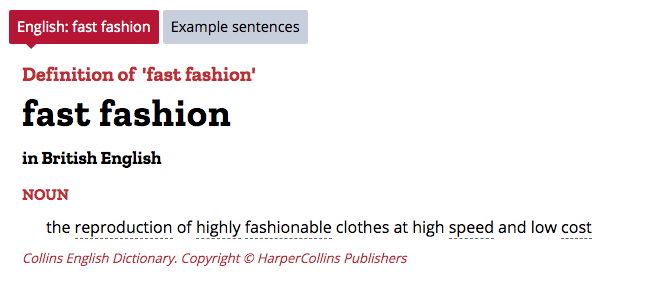
But there will be people who can afford to shop elsewhere, who can afford to make more ethical choices, but who choose not to. If that's you, then this post IS for you.
And please know that it comes from a place of compassion, concern for people and planet, and from a desire to spread the word about some of negative impacts fast fashion has on the environment and the people who make our clothes.
It's no judgement on you if you didn't know all the stats and figures I'm going to share. If you hadn't reached the point yet where you've joined the dots between your choices and people and planet.
We can't change what we don't know.
I didn't know until we spent out year buying nothing new. If you'd asked me before that point how my clothes were made, I would have said in a factory. I assumed it was all automated and done by machine.
If you'd asked me what my clothes were made from I would have said cotton, and assumed that was ok because it's a plant, and therefore natural.
But during that year (and since), I've learned that:
- The majority of our clothes are made by people, usually women (80% of garment workers are women) who are sat in often poorly lit factories in unsafe conditions, sewing the same seam on the same garments, day in, day out, hour after hour. For up to 18hours a day. For far less than the living wage they need to be able to feed their family.
- Some garment workers are children. Supply chains for the fast fashion brands are so complex and are sub-contracted so many times, that most of them wouldn't know if there was child labour being used to make their garments.
- Many of our modern clothes (especially fast fashion) are made from synthetic (oil based) fabrics. The oil needs to stay in the ground.
- It takes over 2000L of water to make one t-shirt -that's the same amount of water we drink in 3 years
- All of the above impacts on garment workers and the planet are compounded by the speed with which we in the developed world consume fashion.
- Clothing production doubled between 2002 and 2015
- Globally we consume 80 billion pieces of clothing every year
- We have enough clothing on the planet right now to clothe the next 6 generations of the human race (this is via Patrick Grant from Great British Sewing Bee)
So every time we actively choose fast fashion (if we can afford not to) that's what we're casting our vote for:
child labour, sweatshops, truckloads of garments headed to landfill every single minute.
I don't think any of us wants that.
But the problem is that's not what we're thinking about when we spot a cheap t-shirt, or we're feeling a hacked off with lockdown and want things to feel more normal again and hit the shops.
The system is broken. And that's not our fault.
But one thing we can do (if we can afford to) is decide to step out of that very unjust, unfair, damaging system by making some different choices.
Some more thoughtful choices.
And I'll be sharing with you in coming posts how you can do that.
Is your convenience and desire for a new cheap t-shirt, more important than the safety of garment workers (possibly children) and the future we're creating for our kids?
That sounds very deep, a bit worthy, and not very (ish) but it is the reality we find ourselves in. It's a hugely uncomfortable truth.
And if we CAN afford to make different choices, we owe it people and planet to do so.
What are your thoughts on fast fashion?
12 DAYS OF SUSTAINABLE(ISH) – DAY 5 SUSTAINABLE(ISH) FASHION
OMG OMG OMG OMG OMG....!
It is with HUGE excitement that I bring you this very special mini-series of the Sustainable(ish) podcast to celebrate, and to count down to, the launch of